The Worries Specific to Project-Scale Procurement
- “Will units actually match?” — a batch consistency question that barely exists on a single-unit renovation but dominates at scale.
- “Will this delay handover?” — a lead time and scheduling question, where a single missed batch can cascade across every remaining unit.
- “Who’s accountable if a defect surfaces after handover?” — a documentation and traceability question that depends entirely on whether QC records actually exist.
- “Am I getting real quality control, or just a reassurance?” — a verification question, since “we check everything” is not the same as a documented sampling standard.
Why Multi-Unit Sourcing Is a Different Problem, Not a Bigger One
n a single renovation, a supplier can adjust a color slightly, tweak a dimension on site, or absorb a short delay without any visible consequence. None of those adjustments are free on a multi-unit project — a slightly-off color match becomes visible the moment two adjoining units are viewed together, a dimension tweak that works in unit 3 may not work in unit 47's mirrored layout, and a short delay repeated across dozens of installation slots compounds into a schedule problem for the whole handover.
Batch Consistency: The Risk That Doesn't Exist in a Single Unit
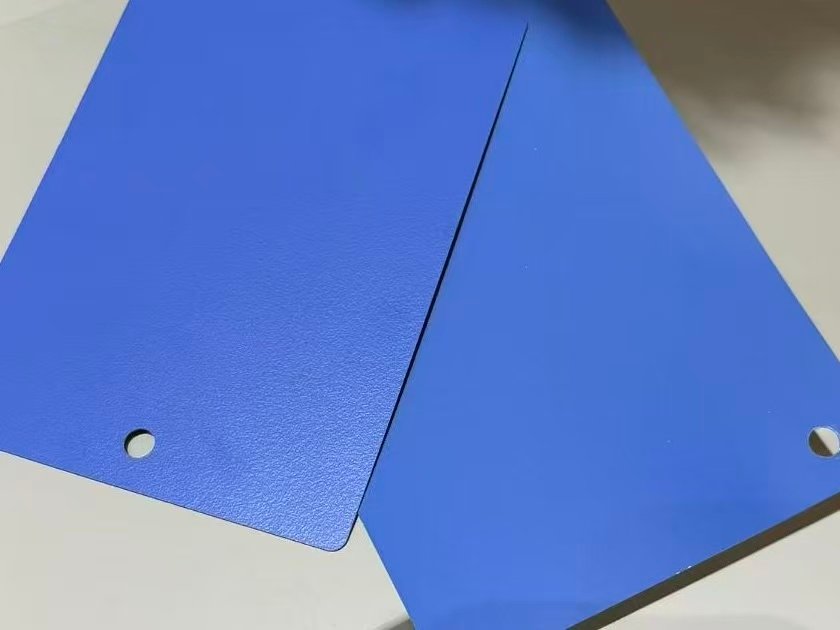
Lacquer and laminate finishes are produced in batches, and a color that matches the approved sample perfectly in batch one can drift subtly by batch ten without tight process control at the factory. On a single-unit renovation this risk barely exists — there’s only one batch. On a multi-unit project spanning months of staged production and installation, it’s the single most common quality complaint at handover.
What to lock before production starts — a retained physical master sample that every subsequent production batch is checked against, not a photo or a color code alone. Color codes and photos can both drift in ways a physical sample comparison catches immediately.
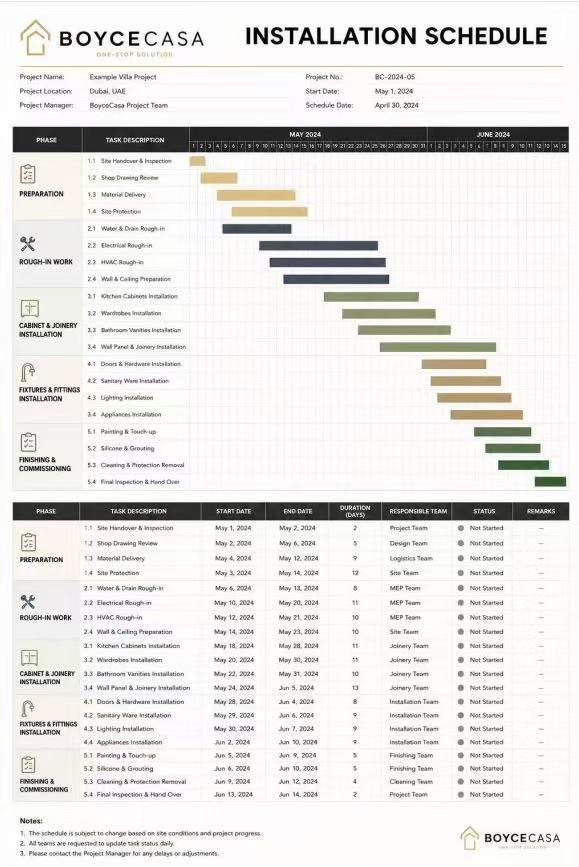
Lead Time Math for Multi-Unit Delivery
Lead time considerations by project scale| Project scale | Key lead time driver | Planning implication |
|---|
| Single unit | Production time only, typically weeks | Minimal scheduling coordination needed |
| 10–50 units (condo/EC block) | Staged production batches + installation sequencing | Production schedule needs to match installation team availability per block/stack |
| 100+ units (large EC/BTO scale) | Multiple concurrent production batches, staged delivery, storage/logistics coordination | Requires locked specifications early — late design changes ripple across every remaining batch |
The larger the unit count, the more expensive a late specification change becomes — not because any single cabinet costs more to change, but because the change has to be threaded through every batch still in production or awaiting installation, each at a different stage.
Installation Sequencing Across Blocks and Stacks
Multi-unit installation typically follows the building’s own handover sequence — block by block, stack by stack — which means cabinetry delivery needs to match that sequence, not arrive as a single bulk shipment expecting on-site storage for units not yet ready for installation. Poor sequencing coordination is a common, avoidable source of on-site congestion and damaged stock waiting in unprotected storage.
Where Standard Layouts Meet Non-Standard Units
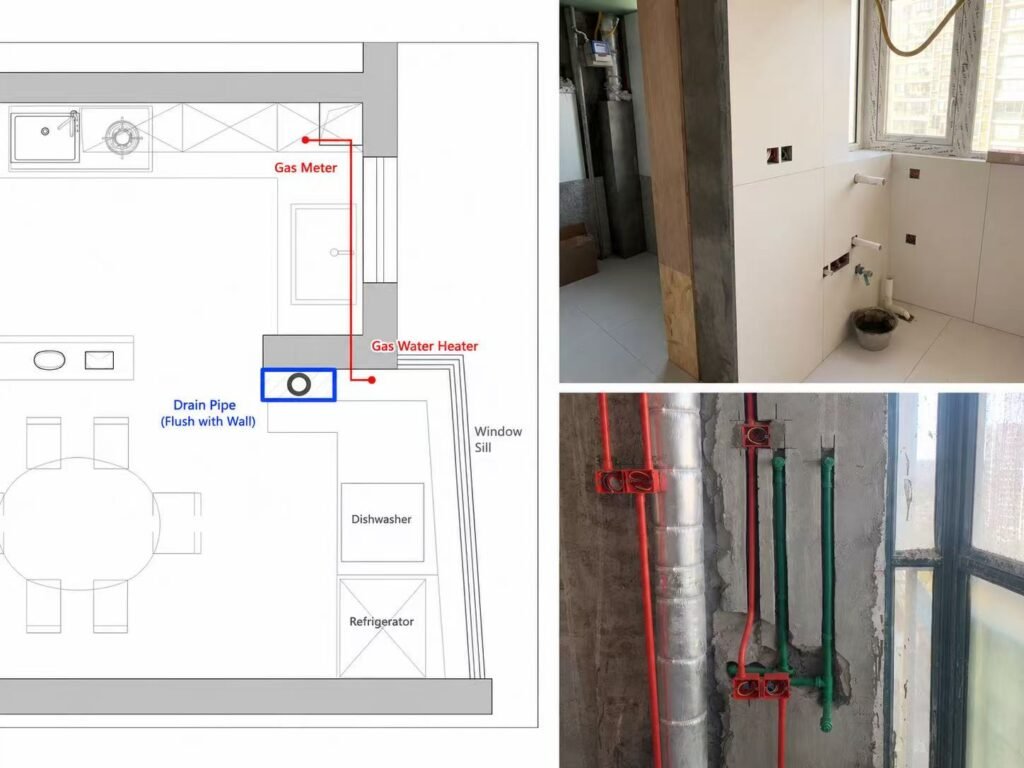
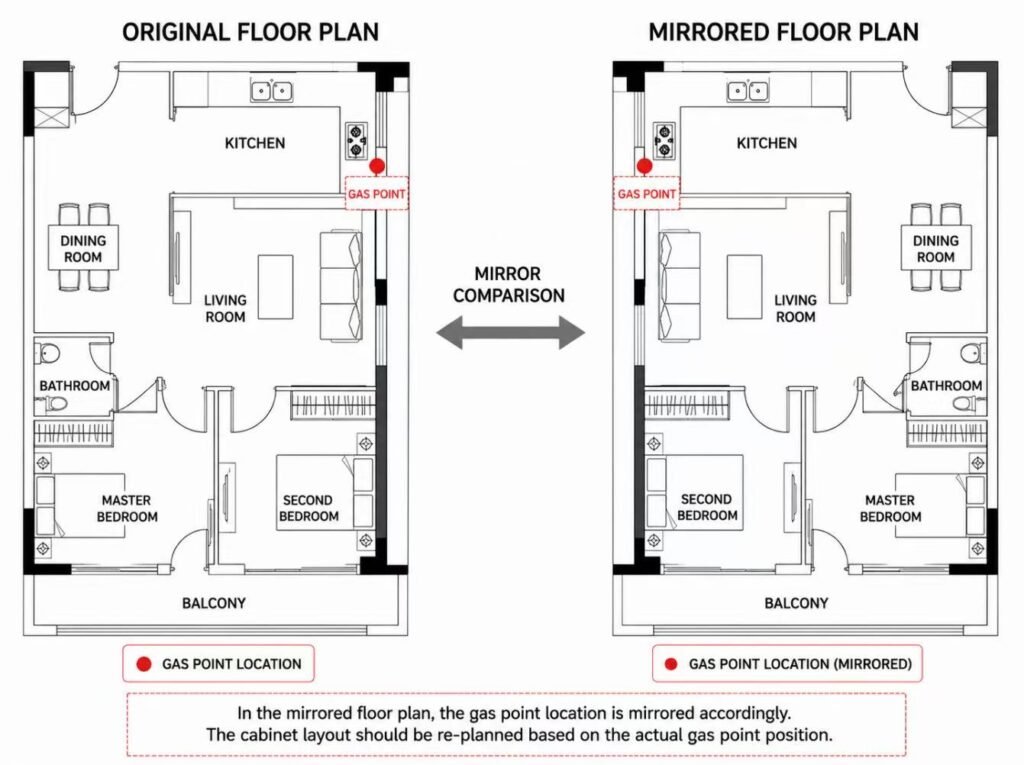
Multi-unit developments are rarely perfectly uniform — mirrored layouts, corner units, and different stack orientations mean a single cabinetry design doesn’t always translate directly across every unit type. Confirming which unit types are genuine mirror-images of the base design (and which only look similar but have a different services layout, such as a relocated gas point or duct run) prevents a costly on-site discovery that a “standard” cabinet doesn’t actually fit a specific unit variant.
Coordinating With MEP Trades at Scale
On a single unit, coordinating cabinetry with gas points, electrical points, and hood ducting is a conversation between a homeowner and one contractor. At project scale, it’s coordination across multiple trades (mechanical, electrical, plumbing) working to their own schedules across many units simultaneously — which makes locking the cabinetry specification against confirmed MEP positions before production even more important than on a single unit, since a mismatch discovered late affects every remaining unit in the batch, not just one. The same gas-point and hood-ducting constraints that apply to a single HDB kitchen still apply here — they’re just multiplied across every unit type in the development.
The QC Checkpoint Most Buyers Never Ask to See
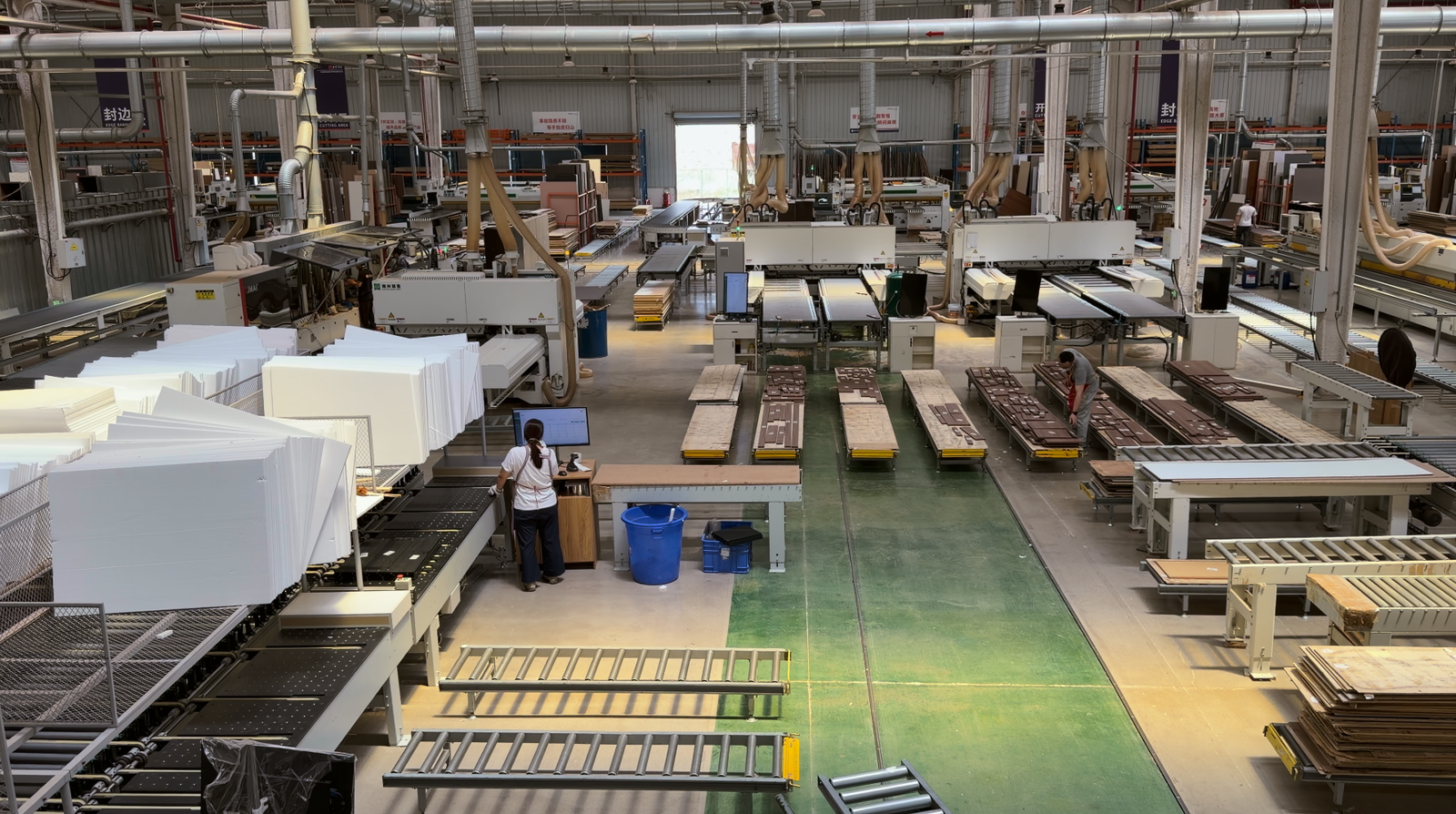
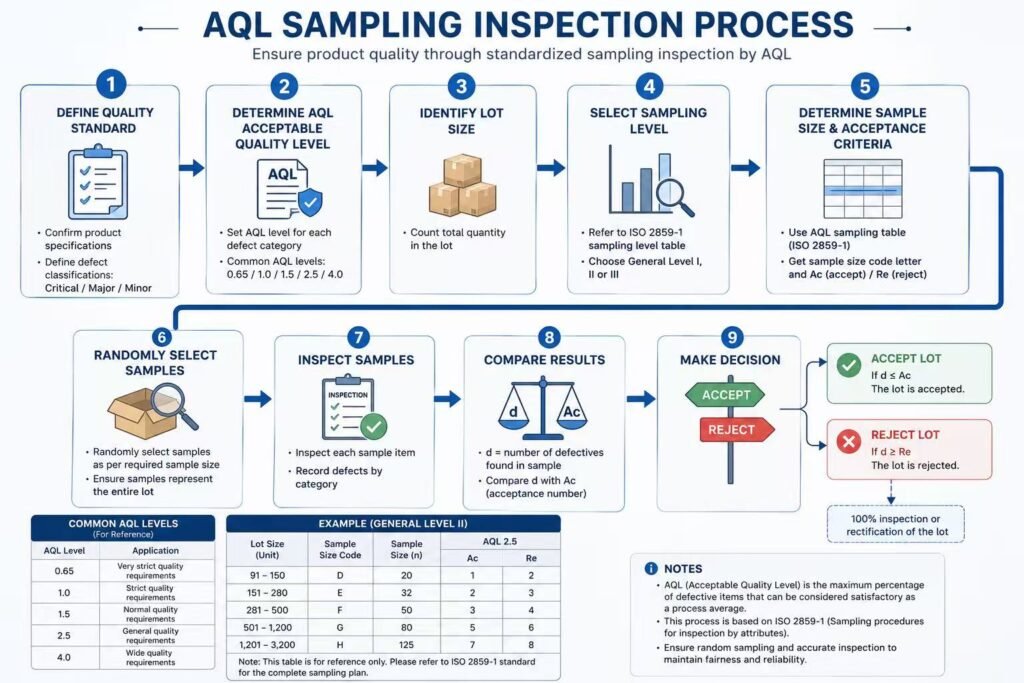
On a single-unit renovation, “quality control” usually means a homeowner looking at the finished cabinet once it’s installed. On a multi-unit order, that’s far too late — the standard practice in manufacturing is a formal sampling inspection at each production batch, using an internationally recognized framework rather than a visual once-over:
AQL (Acceptable Quality Limit) defect tiers commonly applied to cabinetry batches| Defect tier | Typical AQL | Example |
|---|
| Critical | 0% | Structural failure, safety hazard — any occurrence rejects the batch |
| Major | 1.0–2.5% | Door doesn’t close flush, hardware doesn’t function, dimension out of tolerance |
| Minor | 2.5–4.0% | Slight color variation, small cosmetic mark, does not affect function |
Under this AQL framework, a random sample is pulled from each batch — not every single unit — and measured against calibrated dimensional tolerances (checked with calipers or gauges against the approved drawing), functional tests (doors, drawers, soft-close mechanisms operating correctly), and material verification against the specified board and finish. If the sample’s defect count exceeds the accept threshold for its tier, the entire batch is held rather than shipped.
The question worth asking your supplier directly — “What AQL level and inspection stage do you use for a project this size, and can I see a sample inspection report?” A supplier with a genuine QC process will have a ready answer with specific numbers. A vague answer is itself informative.
Photographic Documentation: The Difference Between a Claim and a Record
For a multi-unit project spanning months, a verbal assurance that “batch 6 matched the master sample” is not verifiable after the fact. Photographic documentation at each inspection checkpoint — dated, batch-referenced images of the sample against the master reference — creates a record that can be checked later if a discrepancy is raised at handover, rather than relying on memory or a supplier’s word months after the fact.
Our Standard vs. the Market Minimum at Project Scale
Here’s how BoyceCasa’s multi-unit process compares with what’s commonly left informal in the market:
BoyceCasa standard process vs. common market approach for multi-unit orders| Checkpoint | Common market approach | BoyceCasa standard |
|---|
| Batch color/finish verification | Re-matched by eye, no retained reference | Checked against a retained physical master sample every batch |
| QC sampling standard | Informal, inconsistent between batches | AQL-based sampling with defined tiers for critical/major/minor defects |
| Documentation | Verbal assurance, rarely retained | Dated, batch-referenced photographic records |
| Delivery sequencing | Bulk delivery regardless of installation readiness | Sequenced to match block-by-block installation schedule |
| Unit-variant confirmation | Assumed identical across “standard” units | Mirrored/corner unit variants confirmed against services layout before production |
This comparison matters most at handover — a project with these checkpoints documented has a clear answer when a resident raises a concern; a project without them has only a supplier’s word to fall back on.
Sourcing a Coordinated, Consistent Package at Scale
At BoyceCasa, multi-unit kitchen cabinet orders for Singapore projects are produced against a retained master sample with color and finish verified batch to batch, and production schedules are sequenced to match each project’s actual block-by-block installation plan — not delivered as a single undifferentiated bulk order. This same batch-consistency discipline extends across our wardrobe and interior doors lines for multi-unit developments, including hospitality projects such as our hotel fit-out and villa fit-out work.
Sourcing kitchen cabinets for a multi-unit Singapore development? Lock the master sample and production schedule against your actual installation sequence before the first batch goes into production.
FAQS
Explore our Kitchen Cabinets and Wardrobe collections to see factory-direct cabinetry for villa and hotel projects, or contact our team for a project-specific consultation and quote.
Related reading:
Kitchen Cabinets Singapore: A Sourcing Guide for Developers & Interior Designers
Kitchen Cabinet Materials in Singapore: Density, Moisture Resistance & What the Test Reports Actually Say
HDB & Condo Kitchen Layouts: What Actually Goes Wrong at Installation