The Four Worries Behind Every Material Decision
Before comparing materials, it helps to name what's actually being weighed, because different materials answer different worries better:
- “Is it safe for my family?” — a health and formaldehyde-emission question, most relevant if you have young children, elderly parents, or anyone with respiratory sensitivity at home.
- “Will it hold up in Singapore’s climate?” — a moisture and humidity question, since Singapore’s 80–90% ambient humidity and air-conditioned, closed-window living pattern is genuinely harder on cabinetry than most temperate-climate guides account for.
- “Am I paying the right price for what I’m getting?” — a value question that only makes sense once you know what’s actually inside the quote, not just the surface finish name.
- “Will it still look and function the same in 10 years?” — a durability and hardware question, particularly relevant for a kitchen used daily by a family, not a showroom display.
Which Material Actually Answers Which Worry: The Master Comparison
Here is the full comparison in one place, scored against the four worries above rather than against each other in the abstract:
Ask for the certificate, not the label — a supplier stating “E0” verbally or on a brochure is not the same as a Singapore Green Label or SGBP-certified test report for the specific board batch in your order. Request the certificate before production, not after installation.
Formaldehyde Grade: What E0 and E1 Actually Mean in Numbers
Formaldehyde emission grades get quoted constantly in Singapore renovation quotes, but the actual thresholds are rarely explained:
Formaldehyde emission grades for cabinet boards| Grade | Emission limit | Where it’s appropriate |
|---|
| E0 | ≤ 0.5 mg/L | Bedrooms, wardrobes, sealed cabinetry, children’s rooms — enclosed, air-conditioned spaces |
| E1 | ≤ 9.0 mg/100g | Acceptable minimum for general indoor use with reasonable airflow |
| E2 | ≤ 30.0 mg/100g | Not recommended for enclosed indoor cabinetry — largely phased out by reputable suppliers |
The distinction matters more in Singapore than in drier, better-ventilated climates: homes here are frequently air-conditioned with windows closed for long stretches, and formaldehyde off-gassing accelerates above roughly 30°C — a temperature many enclosed kitchen cabinets reach regularly. In a newly completed BTO or condo where cabinetry across the whole unit is installed around the same time, off-gassing from multiple sources compounds, making the grade specified for kitchen cabinetry a real indoor air quality factor, not a box-ticking exercise.
The honest takeaway — no single material wins on all four worries at once. Solid wood answers the “is it natural and long-lasting once refinished” question best, but loses on Singapore’s humidity specifically. Marine-grade E0 plywood is the strongest all-round answer for Singapore’s climate and health concerns together, which is why it — not solid wood — is generally the technically correct default here, even though solid wood carries more premium perception.
Core Board Density & Water Absorption — The Numbers Behind "Moisture-Resistant"
“Moisture-resistant” is a marketing term; density and water absorption rate are the test data behind it. A representative HMR (high moisture-resistant) particleboard specification commonly used for kitchen cabinetry carries figures along these lines:
Typical HMR particleboard specification| Property | Typical figure |
|---|
| Density | ~630 kg/m³ |
| Water absorption rate | ≤ 8% |
| Modulus of rupture (bending strength) | ≥ 7 MPa |
| Internal bond strength | ≥ 0.33 MPa |
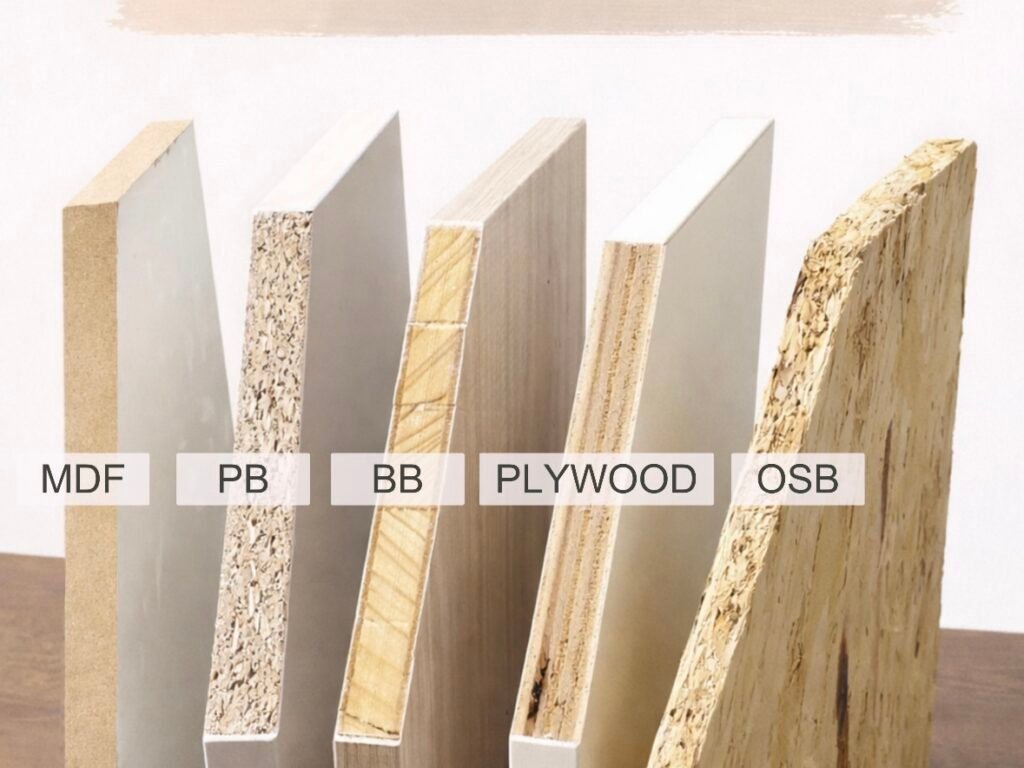
HMR board is typically identifiable by a green-dyed core, distinguishing it from standard particleboard at a glance. Standard (non-HMR) MDF and particleboard are not recommended for Singapore kitchens at all, and should never be used under sink cabinets specifically, where direct water exposure is highest and swelling failure is fastest.
Which zone of the kitchen actually counts as “high water exposure” isn’t always obvious from a floor plan alone — see our breakdown of how wet zone and dry zone boundaries are defined in Singapore kitchens before finalizing which runs need HMR core.
Solid Wood vs. Plywood vs. MDF: Load & Lifespan Numbers
Structural performance by material| Material | Shelf load capacity | Realistic lifespan in Singapore’s climate |
|---|
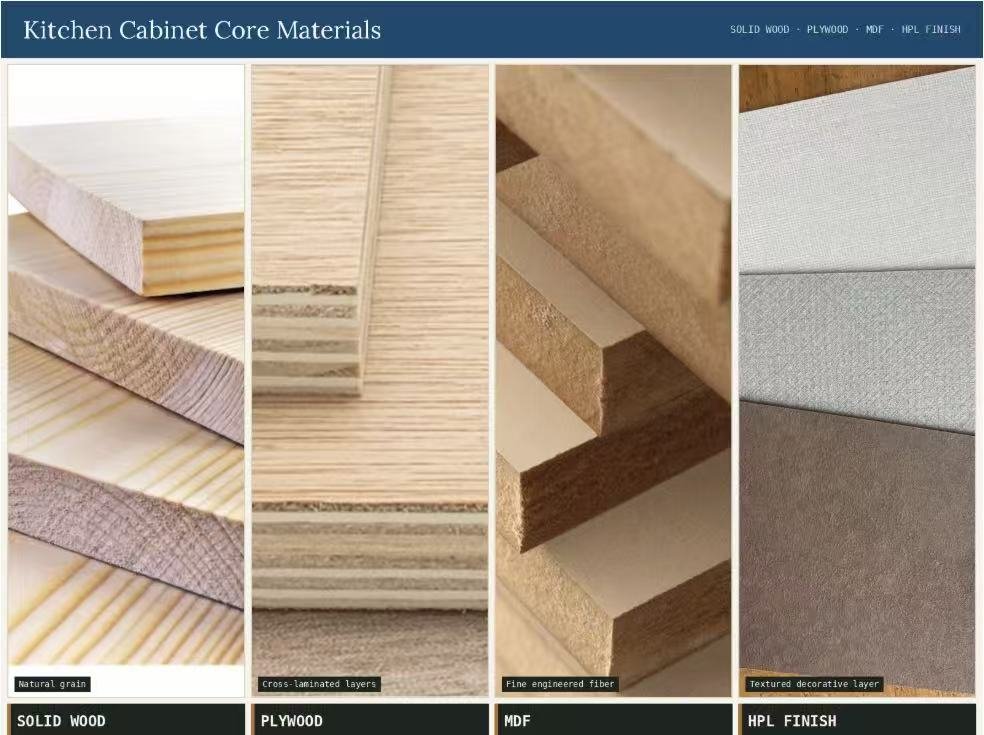
| Marine-grade plywood (cross-laminated) | 40–60 kg per shelf | 15–20 years with basic maintenance |
| HMR-MDF | Lower than plywood | 10–15 years with proper treatment |
| Standard MDF / particleboard | 20–30 kg per shelf (sags beyond this) | 3–5 years — not recommended for Singapore use |
| Solid hardwood (teak, oak, maple) | High, but expands/contracts with humidity | 10–15 years before refinishing typically needed |
Solid wood’s biggest limitation in Singapore isn’t strength — it’s dimensional movement. Singapore’s 80–90% ambient humidity puts solid wood under continuous expansion-and-contraction stress, which over time causes doors to mis-align and drawers to bind, even in premium hardwood species. Cross-laminated marine-grade plywood, with grain layers oriented perpendicular to each other, resists this movement far better, which is why it — not solid wood — is generally the stronger technical choice for Singapore’s climate specifically, even though solid wood often carries the premium positioning.
Hardware Cycle Rating: The Number That Predicts How Long Doors Actually Last
Soft-close hinges and drawer slides are usually sold as a simple upgrade decision, but the difference is a specific, testable number: cycle rating.
- Premium hardware (Blum, Hettich) — typically rated 50,000+ cycles, roughly equivalent to 15–20 years of daily household use.
- Generic/budget hardware — commonly rated 15,000–25,000 cycles, which can translate to failure within 5–8 years under daily use.
This is a case where the cheaper initial quote frequently costs more over the life of the kitchen — hinge and slide replacement, plus the labor to fit it, often exceeds the original hardware price difference.
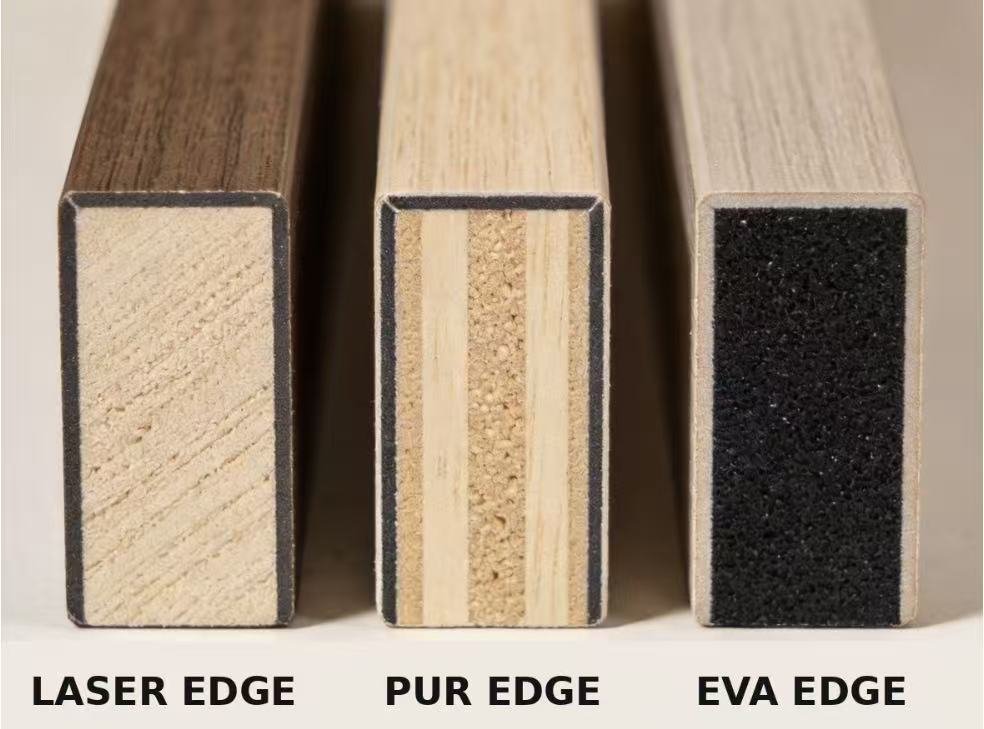
Edge-Banding Adhesive: The 1mm Detail Behind "Why Did the Edge Peel"
Board density and grade get all the attention, but the edge-banding adhesive is where most real-world cabinet failures actually start — and it’s rarely mentioned in a quote at all.
EVA vs. PUR edge-banding adhesive| Property | EVA (standard) | PUR (premium) |
|---|
| Bonding mechanism | Thermoplastic — cools to bond, can re-soften under heat | Thermoset — cures via reaction with air moisture, does not re-melt |
| Application temperature | ~190–210°C | ~120–150°C |
| Moisture/heat resistance | Softens under sustained heat or humidity | Stays bonded under steam, humidity, and heat spikes |
| Glue-line visibility | More visible, more glue used | Thinner line, can be nearly invisible on gloss finishes |
| Typical use | Standard cabinetry, budget-conscious runs | Sink/hob runs, humid climates, premium visible edges |
Edge-banding tape thickness is a second, related number worth asking about: thin banding (~0.3–0.5mm) is common on budget melamine shelving, medium (~1mm) is standard for everyday cabinet doors, and thick banding (2–3mm) gives a rounded, more impact-resistant edge better suited to high-traffic kitchen use. Some premium suppliers now offer laser/zero-joint edge banding, which fuses the banding directly to the panel with essentially no visible glue line — worth asking about specifically for gloss or dark finishes, where glue lines show up more visibly.
Finish Layer: HPL Heat & UV Numbers Worth Knowing
Modern HPL (high-pressure laminate) finishes are commonly rated to resist brief contact with surfaces up to around 180°C, along with UV-fade and scratch resistance — figures worth asking for directly if a kitchen run sits near a window with strong daily sun exposure or beside a cooktop.
These finish-layer numbers apply to a single kitchen — but for multi-unit developments, the harder question is whether the finish stays consistent across dozens of batches. See how batch-to-batch color and finish consistency is controlled on multi-unit projects.
A Five-Minute Showroom Check You Can Actually Do Yourself
Most of the numbers above aren’t things a buyer can verify by eye — but a few physical checks in a showroom or on a sample board take under five minutes and reveal a lot about real-world durability:
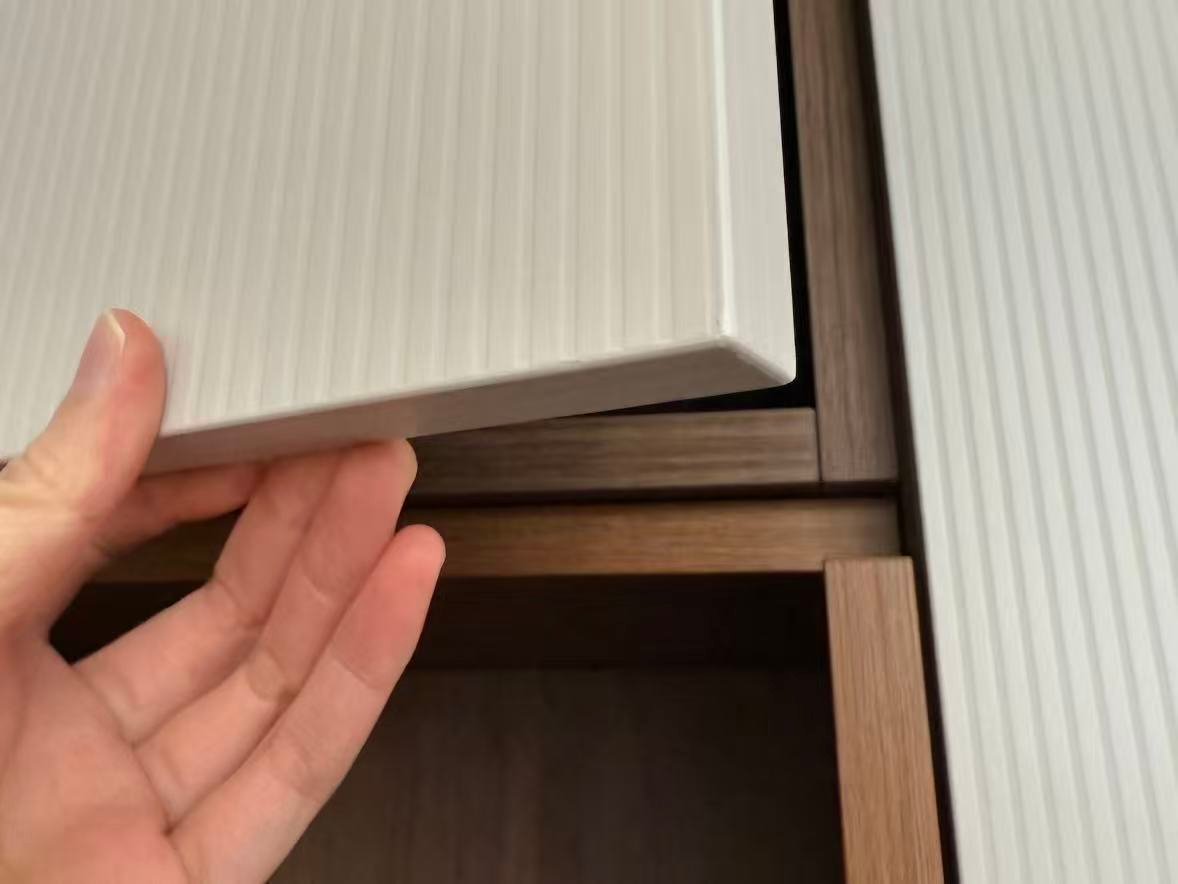
- Run a fingernail along the edge seam — a properly bonded edge shouldn’t catch or show a visible ridge where the banding meets the panel face.
- Look at the edge under strong, angled light — visible glue overflow, glossy patches, or an uneven seam line signal poor adhesive application, regardless of which adhesive type was used.
- Press firmly on a corner — a corner that flexes or shows a hairline gap opening under light pressure suggests weak bonding at exactly the point most exposed to daily knocks.
- Ask to see the reverse or underside of a sample — a supplier confident in their edge quality will show the less flattering angles, not just the front face under showroom lighting.
- Weigh two competing door samples of the same size in your hands — a noticeably lighter sample often signals a lower-density core, even when both are marketed under the same material name.
Why this matters more than the finish photo — two cabinet doors can look visually identical in a catalogue photo while differing enormously in the five points above. The photo tells you about the design; these checks tell you about the years of daily use ahead.
Why Singapore's Climate and Lifestyle Change the Calculation
Two everyday realities of Singapore living put more stress on kitchen cabinet materials than most general guides account for:
- Closed, air-conditioned living — Singapore homes are frequently air-conditioned with windows closed for long stretches, and formaldehyde off-gassing accelerates above roughly 30°C, a temperature many enclosed kitchen cabinets reach regularly in daily use. This is precisely why the formaldehyde grade matters more here than in a well-ventilated, naturally cooled home.
- Wok cooking and heavy daily use — high-heat wok cooking common in Singaporean households produces more oil, steam, and heat exposure at the cabinet surface directly around the hob than milder Western cooking styles. Cabinets in this zone face a harder daily test than a generic material rating captures, which is why edge-banding and finish choice near the hob deserve more attention than the rest of the kitchen run.
- Compact kitchen footprints, high touch frequency — smaller HDB and condo kitchens mean cabinet doors and drawers get opened more often relative to the kitchen’s size, since there’s less spread-out storage to distribute the wear. This makes hardware cycle rating a bigger real-world factor in a compact Singapore kitchen than in a larger, lower-frequency-use kitchen elsewhere.
What this means in practice — a material rated adequately for a well-ventilated, spacious Western kitchen with occasional cooking is being asked to do more work in a compact, air-conditioned, wok-cooking Singapore kitchen used daily by a family. The specification bar should be set accordingly, not copied from a generic international guide.
Our Standard vs. the Market Minimum
Because material names alone don’t tell you what’s actually inside a quote, here’s how BoyceCasa’s standard specification compares with the minimum commonly seen in the Singapore market:
BoyceCasa standard specification vs. common market minimum| Specification | Common market minimum | BoyceCasa standard |
|---|
| Formaldehyde grade | E1, sometimes unverified | E0 as standard, certificate provided per order |
| Core panel (wet zones) | Standard MDF/particleboard, occasionally mislabeled as moisture-resistant | HMR core specified for sink and hob runs as standard, not an upgrade |
| Edge-banding adhesive | EVA, unspecified in most quotes | PUR specified for wet-zone and high-exposure runs |
| Hardware cycle rating | Often unstated; generic hardware common | 50,000+ cycle-rated hinges and slides as standard |
| Batch color verification | Rarely formalized | Checked against a retained master sample every batch |
This isn’t a claim to take on faith — every line above is backed by the test certificate or hardware specification sheet for your specific order, available before production begins.
Sourcing Cabinets With Verified, Not Claimed, Specifications
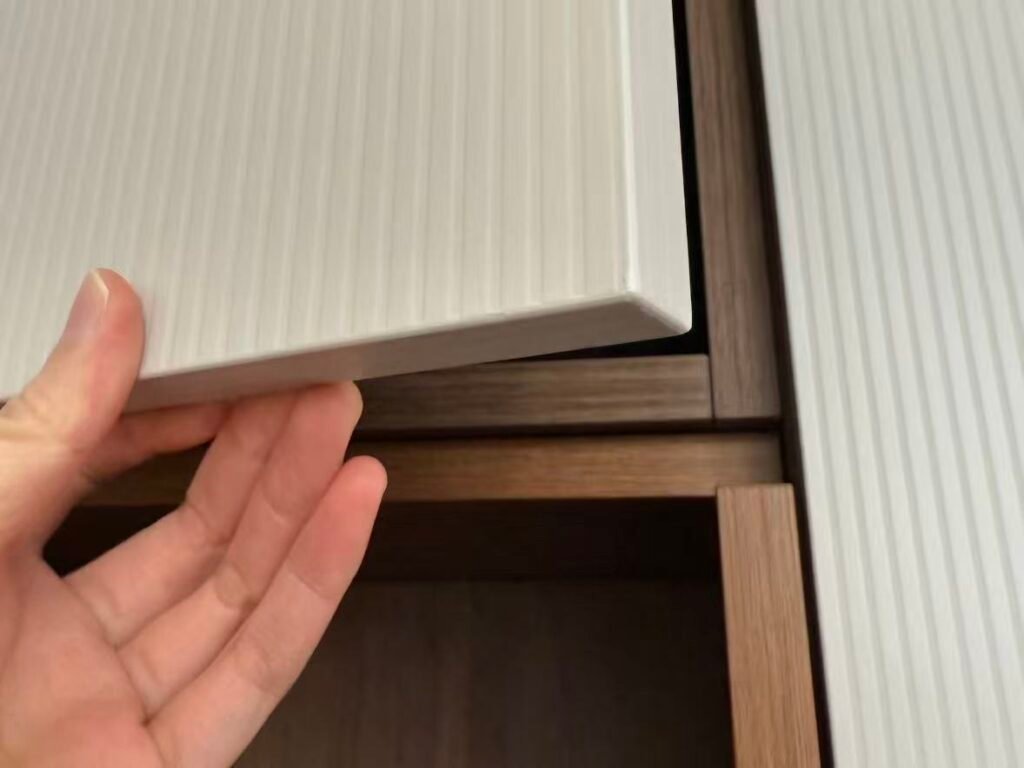
At BoyceCasa, kitchen cabinet material specifications — board density, water absorption rate, formaldehyde grade, and hardware cycle rating — are backed by test certificates provided before production, not stated as a general claim after the fact. This same verification standard applies across our kitchen cabinets, wardrobe, and interior doors lines for every Singapore project — including our white lacquer glass texture cabinetry, which follows the same E0 and batch-verification standard described here.
Comparing kitchen cabinet quotes in Singapore? Ask each supplier for the density, water absorption, and formaldehyde test certificate for your specific order — not just the grade name.
FAQS
Explore our Kitchen Cabinets and Wardrobe collections to see factory-direct cabinetry for villa and hotel projects, or contact our team for a project-specific consultation and quote.
Related reading:
Kitchen Cabinets Singapore: A Sourcing Guide for Developers & Interior Designers
HDB & Condo Kitchen Layouts: What Actually Goes Wrong at Installation
HDB & Condo Kitchen Layouts: What Actually Goes Wrong at Installation