

In the pursuit of personalized spaces and premium living, mass-produced furniture often falls short of capturing the true essence of a home.
As modern minimalism and light luxury styles continue to dominate global design trends, high-end custom furniture has become the absolute core of creating an ideal living space.However, the custom furniture market can be highly complex.
Bridging the gap between a stunning design blueprint and the final product involves navigating materials, hardware, and craftsmanship. Here is how to choose bespoke luxury furniture like a professional designer.
"Energy efficient" on a spec sheet means almost nothing without the two numbers behind it: U-factor and SHGC. Here's what they measure, why SHGC matters more than U-factor in hot climates, and what actually moves the needle on cooling cost.
Every window and door product page uses the phrase "energy efficient." Almost none explain what that claim is actually measured against. Two numbers do the real work — U-factor and SHGC — and which one matters more depends entirely on whether the building is trying to keep heat in or keep heat out.
Part of — Windows and Doors: A Complete Buying & Sourcing Guide
U-factor measures the rate of heat transfer through a window or door — lower is better, meaning less heat passes through. It matters in both hot and cold climates, but its practical impact differs: in cold climates, a low U-factor keeps interior heat from escaping; in hot climates, it slows exterior heat from entering, though it works alongside — not instead of — SHGC in that scenario.
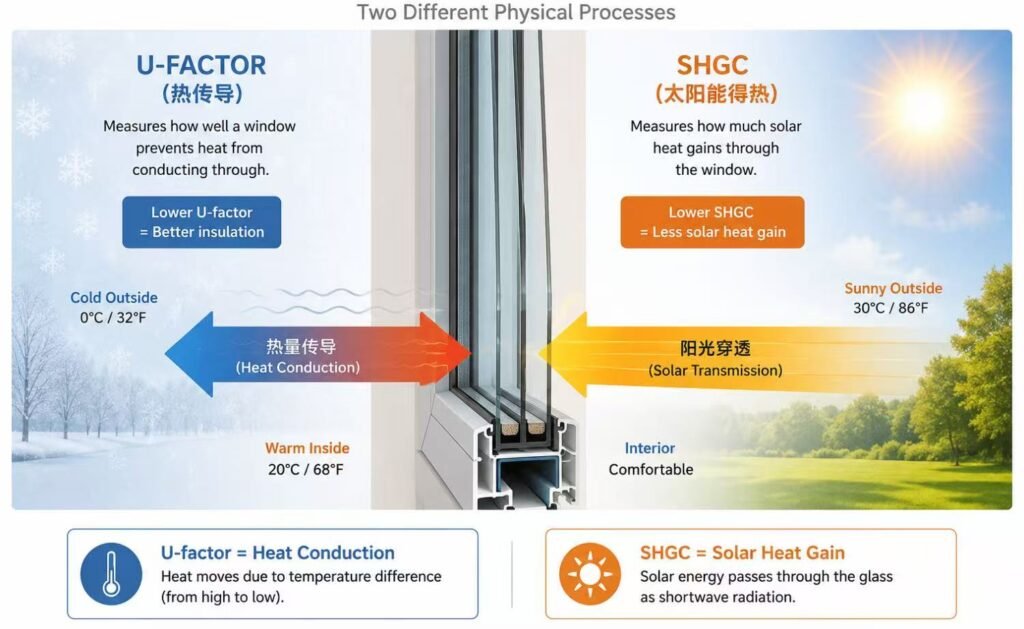
Solar Heat Gain Coefficient (SHGC) measures how much solar radiant heat passes through the glass — a number between 0 and 1, where lower means less solar heat gets through. For Southeast Asian and Middle Eastern projects specifically, SHGC is generally the more important of the two figures: a low-SHGC glazing package directly reduces the solar heat load a building's air conditioning has to work against, which is usually the dominant driver of a hot-climate building's energy cost.
Certification programs like ENERGY STAR set minimum U-factor and SHGC thresholds by climate zone, giving buyers a baseline reference rather than a single global standard — a window certified for a cold-climate zone is not necessarily well-suited to a hot, high-sun climate, since the certification thresholds differ by zone specifically. Checking which climate zone a certification applies to is as important as checking that a certification exists at all.

FAQS
Explore our Kitchen Cabinets and Wardrobe collections to see factory-direct cabinetry for villa and hotel projects, or contact our team for a project-specific consultation and quote.Related reading:
Windows and Doors: A Complete Buying & Sourcing Guide
Window and Door Materials
Aluminium Doors & Windows for Hot Climate Projects
Kitchen Cabinets Singapore: A Sourcing Guide for Developers & Interior Designers
Kitchen Cabinet Materials in Singapore: Density, Moisture Resistance & What the Test Reports Actually Say
HDB & Condo Kitchen Layouts: What Actually Goes Wrong at Installation