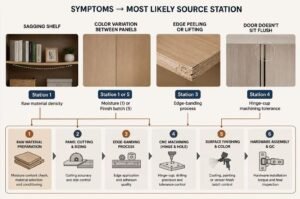
In the pursuit of personalized spaces and premium living, mass-produced furniture often falls short of capturing the true essence of a home.
As modern minimalism and light luxury styles continue to dominate global design trends, high-end custom furniture has become the absolute core of creating an ideal living space.However, the custom furniture market can be highly complex.
Bridging the gap between a stunning design blueprint and the final product involves navigating materials, hardware, and craftsmanship. Here is how to choose bespoke luxury furniture like a professional designer.
Kitchen cabinets take more daily punishment than almost any other interior product. They absorb steam from cooking, water splashes from the sink, oil vapor from frying, repeated impact from handles and door edges, and the chemical contact of cleaning products — every single day, for years. In a hotel room kitchenette, that daily use is multiplied by guest turnover. In a villa in a tropical climate, the combination of heat and humidity creates material stress that does not exist in European or Australian conditions.
Which material is best for kitchen cabinets is therefore not a question with a single universal answer. The correct answer depends on the climate zone where the project is located, the type of use the kitchen will experience, the design aesthetic the project requires, and the budget available. A specification that is correct for a premium villa in Kuala Lumpur is different from the correct specification for a serviced apartment development in Dubai, and both are different from the correct specification for a residential development in Sydney.
This guide breaks down the question systematically. It separates the two independent material decisions every kitchen cabinet involves — substrate and surface finish — explains the performance profile of each option, and then provides project-specific recommendations for the villa, hotel, and residential development contexts where these decisions most often need to be made.
Before comparing materials, it is important to understand that every kitchen cabinet involves two separate and independent material decisions, not one.
Substrate vs Surface Finish: Why You Need to Separate These
Six Core Capability Indicators That Separate Top Cabinetry Factories
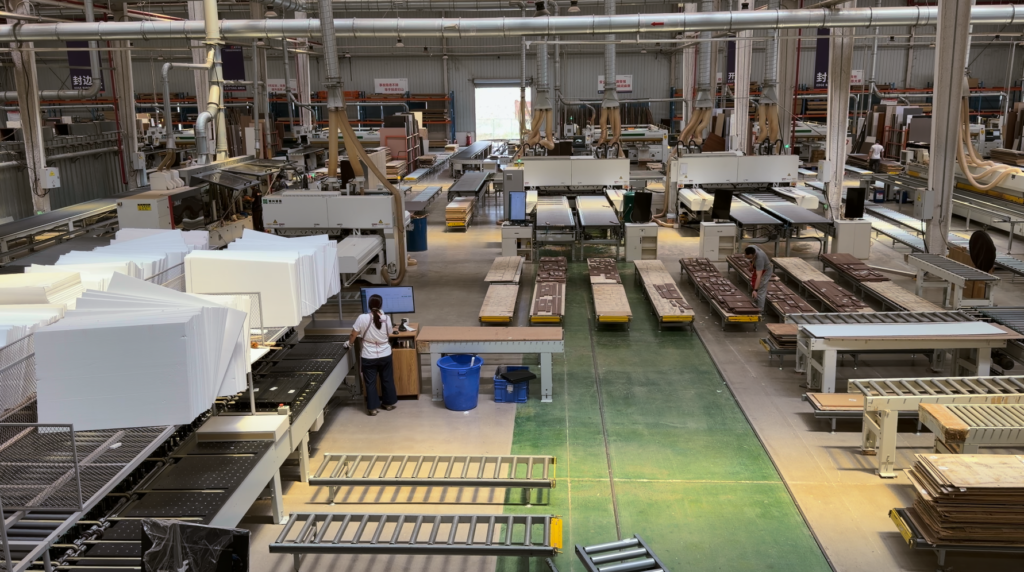
1. Production Equipment: CNC Is the Dividing Line
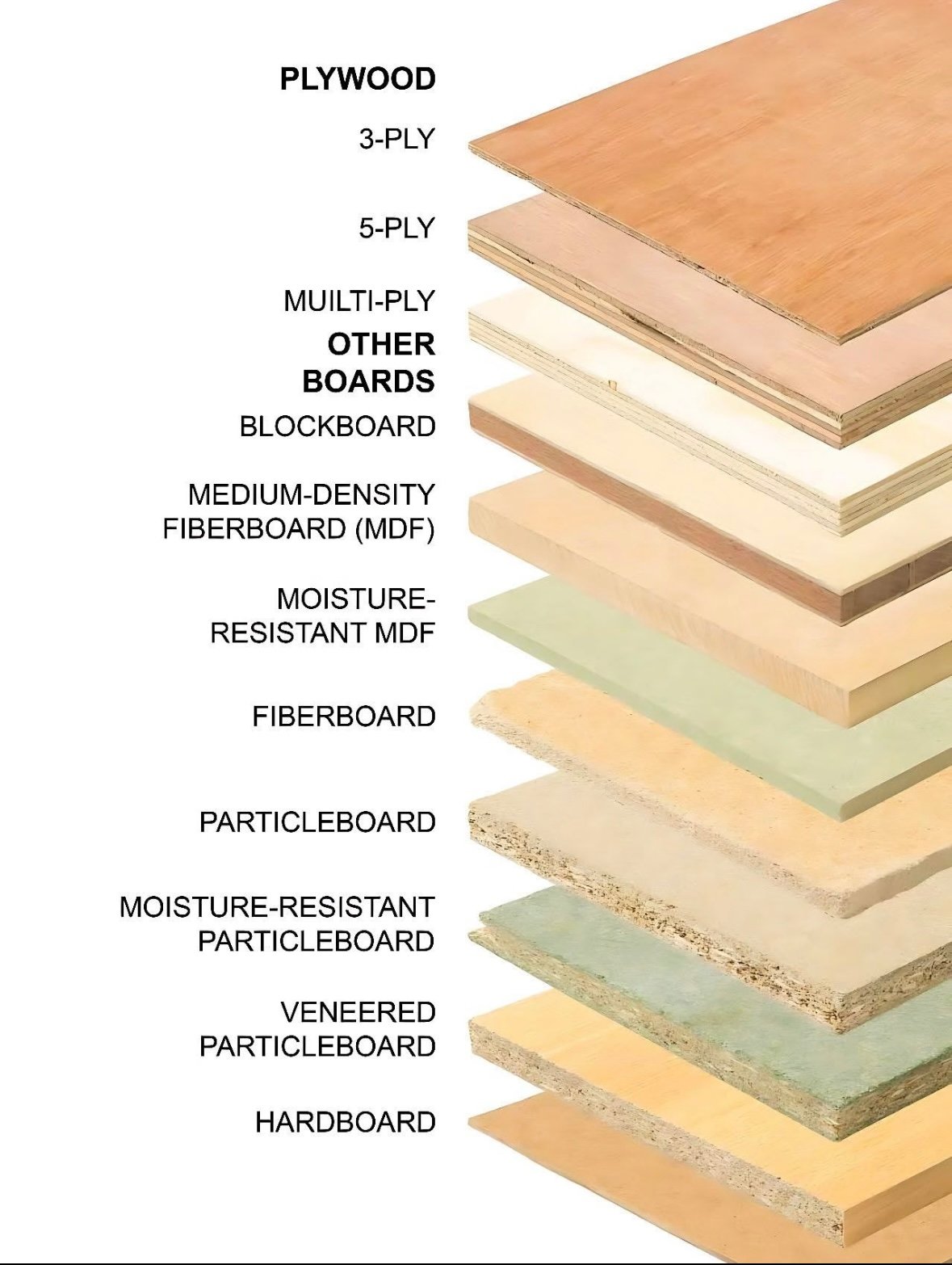
When asking which material is best for kitchen cabinets, the question actually contains two separate decisions: the substrate material that forms the structural body of the cabinet, and the surface finish applied to its visible faces. These decisions are independent, and each determines a different aspect of the cabinet's performance and lifespan.
The substrate — also called the carcass material or core — is the structural element of the cabinet. It determines mechanical strength, moisture resistance, hardware holding capacity, dimensional stability over time, and formaldehyde emission levels. You do not typically see the substrate in the finished installation — it is covered by the surface finish — but its quality determines how the cabinet performs over the years.
The surface finish is what you see and touch. It determines the visual appearance, the colour and texture options available, the scratch and stain resistance of the visible surface, and how easy the cabinet is to clean and maintain.
The confusion that leads to many poor kitchen cabinet purchasing decisions is treating these as a single decision. "Solid wood versus MDF" is commonly asked as if it were a single comparison, but solid wood can refer either to the substrate being natural timber or to the surface being a real wood veneer over an engineered board substrate. Separating these two decisions is the first step to choosing the right specification for any project.
Kitchen Cabinet Substrate Materials: What Is Inside Determines How Long It Lasts
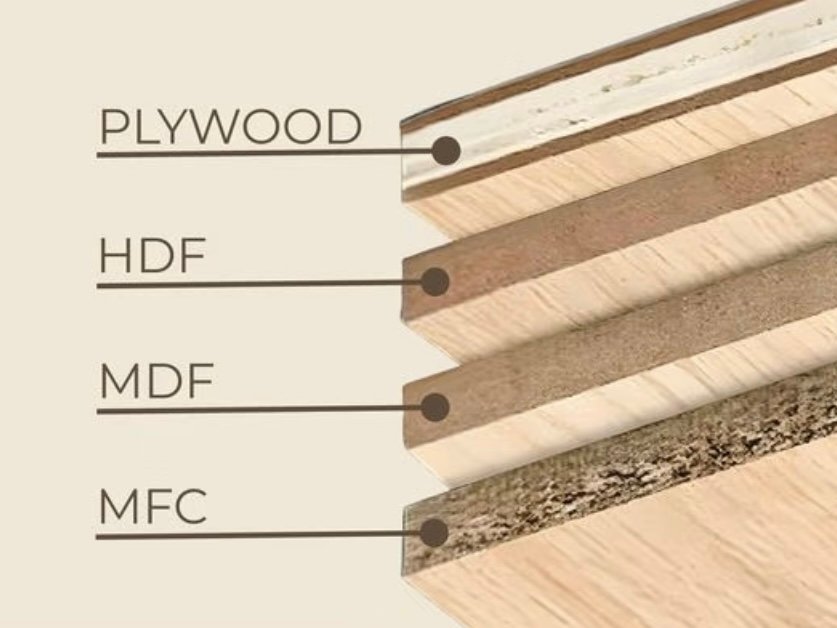
Hardwood Plywood: The Best All-Round Substrate for Demanding Projects
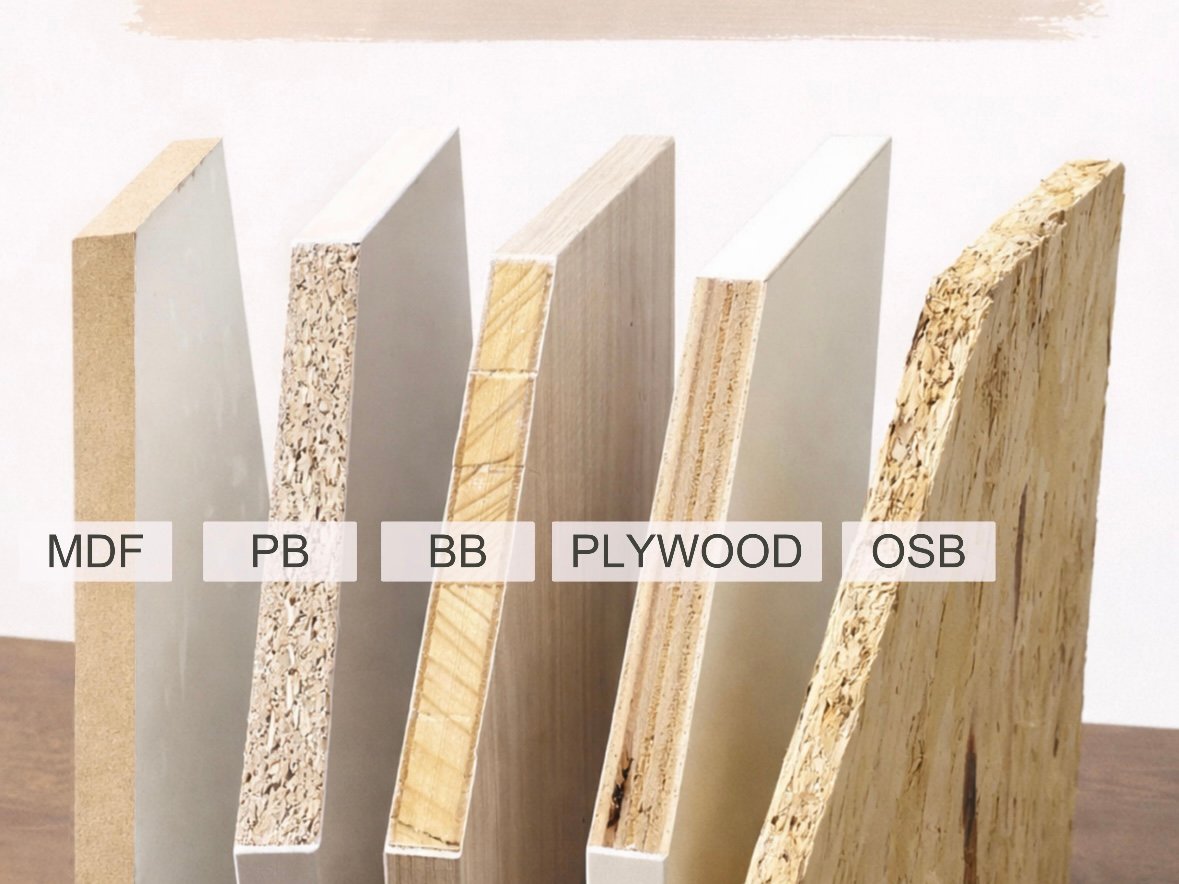
Hardwood plywood is manufactured by bonding multiple thin timber veneers in alternating grain directions under high pressure. The cross-grain construction is what gives plywood its distinctive performance advantages over other engineered board options.
MDF: The Right Substrate for Lacquer and Acrylic Finishes
Medium density fiberboard is manufactured from wood fiber and resin compressed under heat and pressure to produce a uniformly dense, smooth board. Its primary advantage over plywood is surface quality: MDF has no grain variation, no voids, and no surface irregularities, producing a substrate that accepts spray lacquer and acrylic finishes at a quality level that plywood cannot match.
This surface quality advantage is real and significant. When a kitchen cabinet door requires a flawless high-gloss lacquer finish with no visible texture through the surface treatment, MDF is the correct substrate. The same finish over plywood, even with careful sanding and filling, will typically show subtle grain variation that is visible in raking light.
MDF's limitations in kitchen applications are equally real. Its moisture resistance is poor — substantially worse than plywood — and in kitchen environments where steam, splashes, and high ambient humidity are regular conditions, standard MDF substrate will absorb moisture at exposed edges and junctions, causing swelling and surface delamination. For kitchen cabinet carcasses (the box of the cabinet, not just the door), standard MDF is not appropriate in tropical climates or for any position near a sink or dishwasher.
The appropriate application for MDF in kitchen cabinetry is as the substrate for door panels where a lacquer or acrylic surface finish is specified, combined with a plywood carcass for the structural cabinet body. This combination — plywood body, MDF door panel — captures the moisture resistance and hardware performance of plywood where it matters most, while capturing the surface quality of MDF for the visible door face.
Moisture-resistant MDF (HMR MDF) improves the moisture performance of standard MDF significantly through the inclusion of moisture-resistant additives in the manufacturing process. It is appropriate as a cabinet body substrate in tropical climates for mid-range projects where the plywood cost premium is a constraint, provided that edge sealing is executed correctly.
Particleboard: The Economy Option with Real Limitations
Particleboard is the lowest-cost engineered board substrate and the most widely used in volume residential cabinet production globally. It is manufactured from wood particles and resin bonded under pressure, producing a board that is heavy, stable on a flat surface, and inexpensive to produce in large quantities.
Its limitations for kitchen applications are well established. Moisture resistance is the weakest of all substrate options — particleboard at an unsealed edge will visibly swell within hours of contact with water, and the swelling is permanent. In any kitchen position near a sink, dishwasher, or area with regular steam exposure, particleboard substrate will show edge swelling within one to three years if the edge sealing has any gaps or damage.
Hardware holding capacity in particleboard is substantially lower than in plywood. The compressed particle structure does not grip fasteners as firmly as the layered wood structure of plywood, and repeated loading cycles cause the substrate around fasteners to compress gradually. For kitchen cabinets in hotel or serviced apartment applications — where the same hinges and drawer runners are opened and closed thousands of times per year — particleboard substrate creates a maintenance liability that is predictable and avoidable.
Particleboard is appropriate for kitchen cabinetry in economy residential development projects in dry climates, where the expected occupancy pattern is lower frequency use and budget is the primary procurement criterion. It is not appropriate for hotel projects, tropical climate applications, or any project where long-term performance without maintenance intervention is a requirement.
Formaldehyde emission risk with particleboard is the highest of all substrate options. The high adhesive content of particleboard production, relative to plywood, results in higher formaldehyde emission levels from uncertified products. E1 certification is the minimum requirement; E0 should be specified wherever occupants will spend significant time.
Solid Timber: The Highest Quality and the Most Demanding
Solid timber kitchen cabinets use natural wood as both the structural substrate and the visible surface. The visual quality — the depth of natural grain, the warmth of genuine material — is impossible to replicate with any engineered alternative. Solid timber is also the only substrate that can be refinished: sanded and recoated to restore its surface to near-original condition, extending its useful life significantly beyond any surface-treated engineered board.
The limitations of solid timber for kitchen applications in tropical and subtropical markets are severe. Timber responds to changes in ambient humidity by expanding and contracting across its grain — a process that is not reversible and that accumulates into dimensional change over time. In the high-humidity conditions of Southeast Asia or the dramatic temperature differential between the air-conditioned interior and the hot exterior common in the Middle East, solid timber cabinet doors will expand in the wet season and contract in the dry season, binding against frames, losing alignment, and eventually cracking at joints.
Solid timber kitchen cabinets are appropriate for bespoke top-tier villa projects in temperate climates where the natural material aesthetic is a primary design value and ongoing maintenance is a planned part of the ownership model. They are not appropriate for hotel projects, tropical climate projects, or any project where batch consistency and low maintenance are requirements.
Substrate Performance Summary
Kitchen Cabinet Surface Finishes: What You See Determines How It Feels
Surface Finish Performance Summary
Material Recommendations by Project Type
Formaldehyde Standards: What to Verify Before Ordering
Kitchen cabinets are installed in semi-enclosed spaces where occupants spend extended time. Formaldehyde emitted by cabinet materials accumulates in the kitchen environment at higher concentrations than in more open spaces. The health case for low-formaldehyde materials in kitchen applications is strong, and in markets where formaldehyde emission standards are regulated, compliance is mandatory.
For any kitchen cabinet project — regardless of the destination market's regulatory requirements — E0 is the recommended minimum specification. The cost difference between E0 and E1 certified board at the procurement level is small; the accumulated formaldehyde exposure difference in an enclosed kitchen over years of occupancy is not.
Verification requires a third-party laboratory test certificate — not a manufacturer self-declaration. SGS, Bureau Veritas, Intertek, and CTI are among the accredited testing bodies whose certificates are recognised across international markets. Request the certificate number and issuing laboratory alongside the document so it can be independently verified.
What to Confirm Before Ordering from an Overseas Cabinetry Factory
FAQS
Conclusion:
Related reading:— White Lacquer Glass Texture Kitchen Cabinets: Design Guide for Villa & Hotel Projects
— Which Material Is Best for Kitchen Cabinets? Complete Guide for Villa & Hotel Projects
— Cabinetry Factory: How to Choose the Right Custom Cabinet Manufacturer for Villa and Hotel Projects
— Woodwork Wardrobe: Design Styles, Materials & Custom Guide for Villa and Hotel Projects
— Turnkey Interior Solutions: The Complete Guide for Property Projects
— What Is a Flush Door? Complete Guide to Types, Materials & Project Applications
— Hotel Fit-out Projects: Case Studies and Delivery
— Villa Fit-out Projects: Full-House Interior Solutions