Blog

Living Room Storage Cabinets: The Sizing and Structure Behind a System That Actually Works

Cabinet quality control process defect diagnosis

In the pursuit of personalized spaces and premium living, mass-produced furniture often falls short of capturing the true essence of a home.

As modern minimalism and light luxury styles continue to dominate global design trends, high-end custom furniture has become the absolute core of creating an ideal living space.However, the custom furniture market can be highly complex.

Bridging the gap between a stunning design blueprint and the final product involves navigating materials, hardware, and craftsmanship. Here is how to choose bespoke luxury furniture like a professional designer.

A living room storage cabinet looks like a styling choice — pick a shape, a finish, a spot against the wall. What actually determines whether it stays useful is the layer underneath: shelf depth and load capacity when you're planning it, and production tolerance when something eventually goes wrong.

Read time — 14 min
Covers — Sizing · Materials · Production & QC
Scope — Residential & hospitality projects

Most living room storage content covers the same ground: why you need it, which cabinet type suits which room, which style to follow. Genuinely useful for narrowing down a look — but it stops short of explaining why a well-chosen cabinet still develops problems over time. This guide covers both halves: the planning numbers that determine whether a cabinet is sized right, and the production sequence that determines whether it's actually built right.


Part One

Planning the Storage System


01

What Actually Belongs in a Living Room Cabinet

Books, electronics, blankets, display decor, and media equipment are the usual contents of a living room storage cabinet — but each category has a genuinely different storage requirement. Books need shelf depth and load-bearing strength. Electronics need ventilation and cable routing. Blankets and linens need larger, flexible volume. Decor needs visibility, not concealment. A cabinet designed around one generic "storage" concept rarely serves all of these well — the internal structure should follow what's actually going inside.
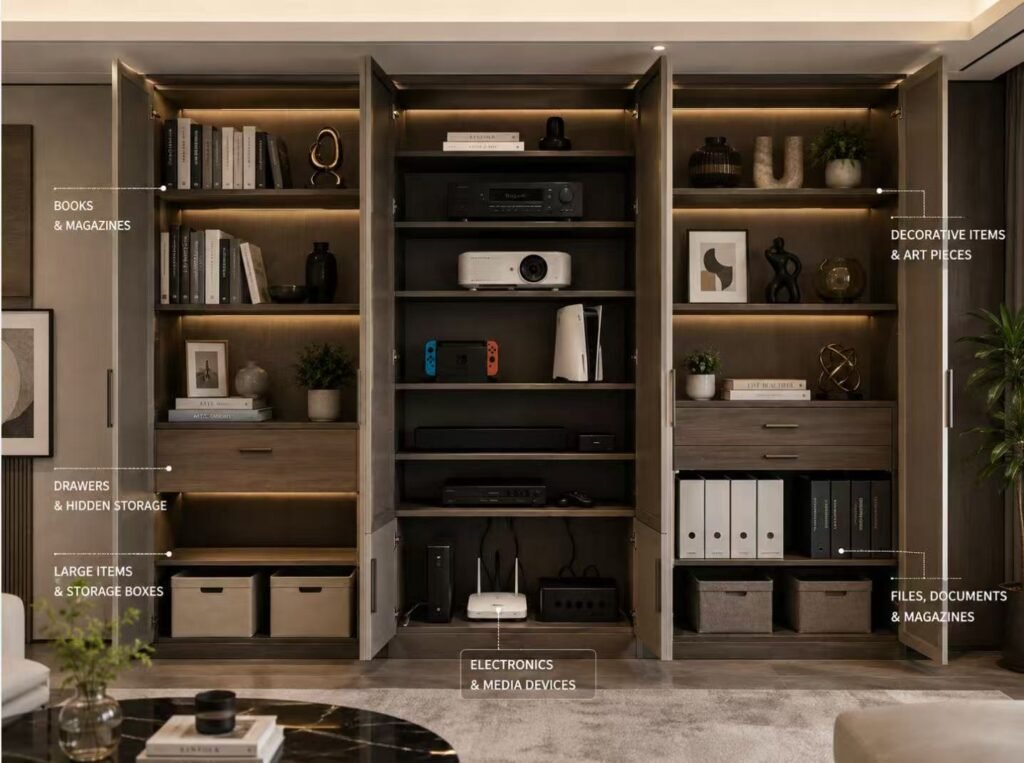
Living room storage cabinet interior organization

02

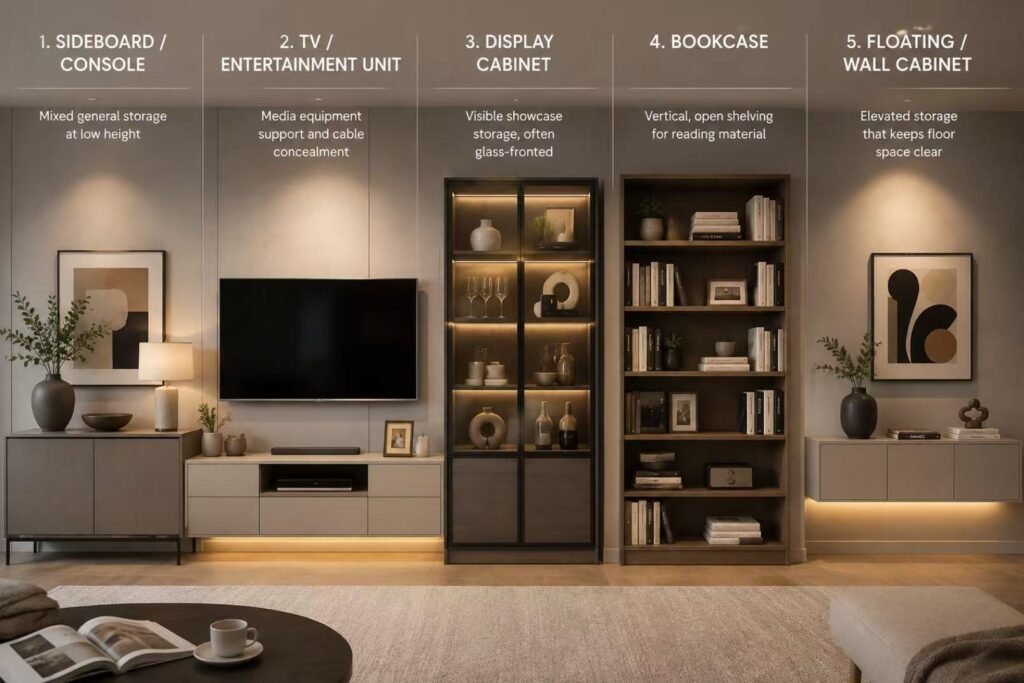
Cabinet Types by Function, Not Just Name

Living room cabinet types comparison display
Living room cabinet types by function
TypePrimary functionTypical contents
Sideboard / consoleMixed general storage at low heightTableware, linens, media accessories
TV / entertainment unitMedia equipment support and cable concealmentTV, soundbar, media players, remotes
Display cabinetVisible showcase storage, often glass-frontedDecor, glassware, collectibles
BookcaseVertical, open shelving for reading materialBooks, magazines, binders
Floating/wall cabinetElevated storage that keeps floor space clearLighter items, decor, small electronics


03

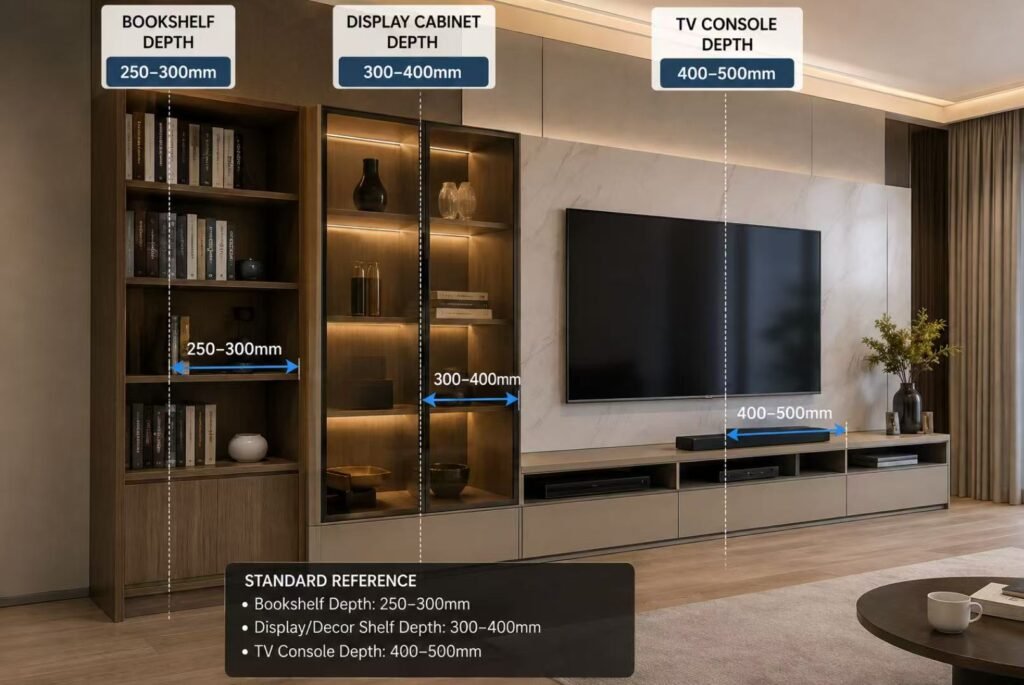
Sizing Reference: Depth, Height & Clearance

Living room cabinet depth size guide
Living room cabinet sizing reference
ElementTypical dimensionWhy it matters
Bookshelf depth250–300mmMatches standard book sizes without wasted space
Display/decor shelf depth300–400mmAccommodates larger decorative items and small electronics
TV console depth400–500mmSupports media equipment and cable routing behind the unit
Walkway clearance in front900mm minimumMaintains comfortable room traffic flow
Door/drawer opening clearanceSlab width + 50–100mmPrevents doors or drawers catching on adjacent furniture

04

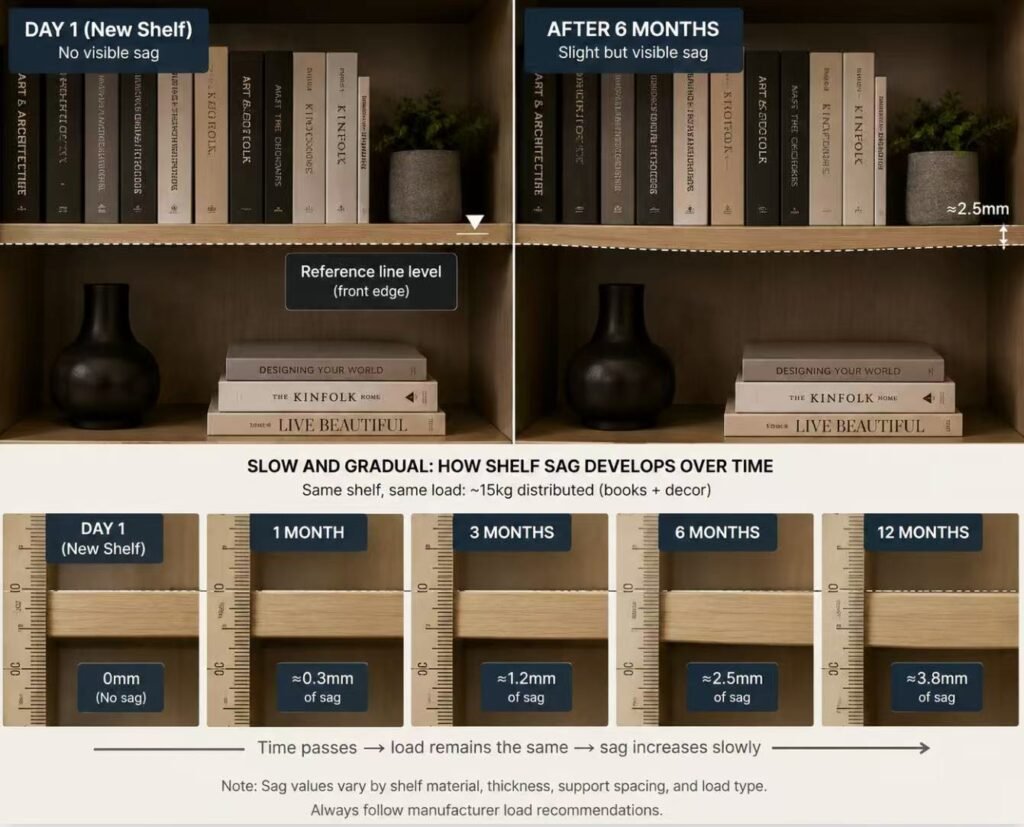
Shelf Load Capacity: What Books and Electronics Actually Weigh

  • Paperback books — roughly 200–340g each.
  • Hardback novels — roughly 500g–1kg each.
  • Coffee-table and art books — 1.5–3kg each, sometimes more for large-format titles.
Cabinet shelf sag after long term load
Shelf material load capacity (18mm thickness, 600–800mm span)
MaterialSafe load before visible sag
MDF~20–25kg (drops to 15–20kg beyond 800mm span)
ParticleboardLower than MDF — more prone to bowing under sustained load
Solid wood (oak, ash, walnut)Meaningfully higher than MDF at the same thickness


Why shelves fail slowly, not suddenly — an under-specified shelf doesn’t collapse — it bends a fraction of a millimeter at a time, and the sag only becomes visually obvious months after the load was placed.

05

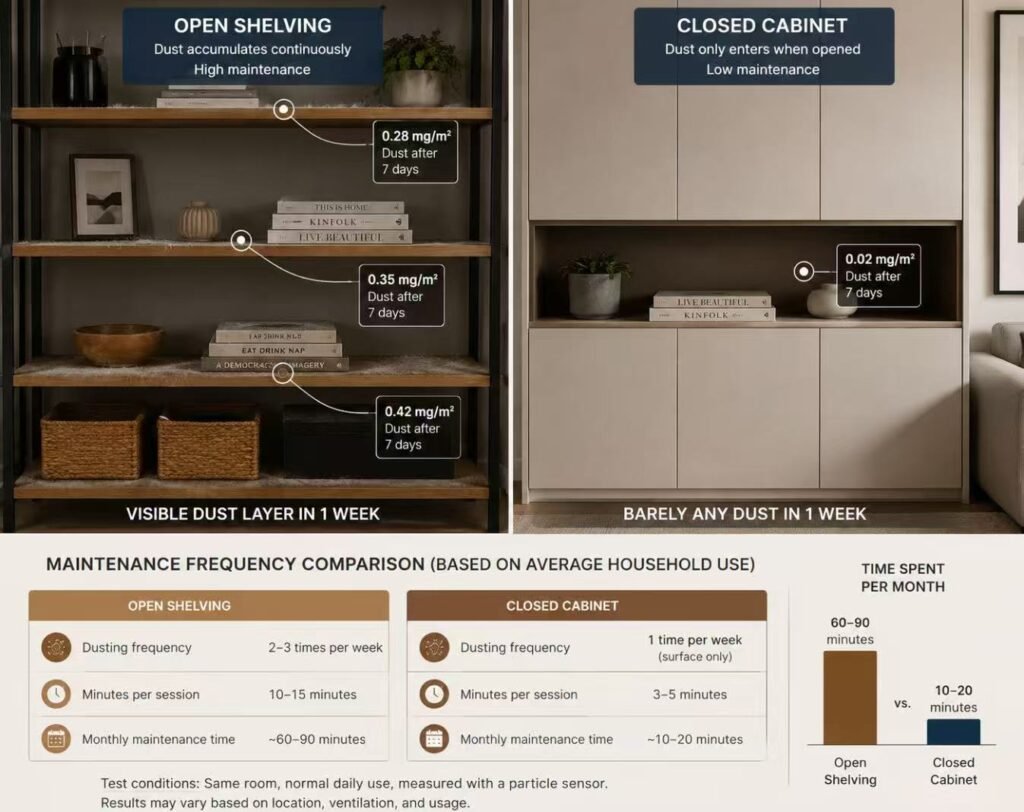
Material Comparison & Open vs. Closed Storage

Open shelving versus closed cabinet maintenance
Living room cabinet material comparison
MaterialLoad capacityMaintenance
Solid woodHighHigher — sensitive to humidity swings
Engineered wood (MDF/plywood)Moderate, grade-dependentLow, especially with a durable finish layer
GlassLow — display use, not load-bearingRequires regular cleaning
Metal-framedHighLow, though scratches show over time

Open shelving and closed cabinets get compared mostly on appearance, but the practical difference is maintenance frequency: open shelving accumulates dust on every exposed surface continuously, while closed cabinets only expose contents to dust when the door is opened — a bigger factor for high-traffic living rooms or hospitality settings than the visual preference alone.

Part Two

Why Living Room Cabinets Actually Fail


06

A Cabinet Isn't Assembled — It's Built Through Sequential Stations

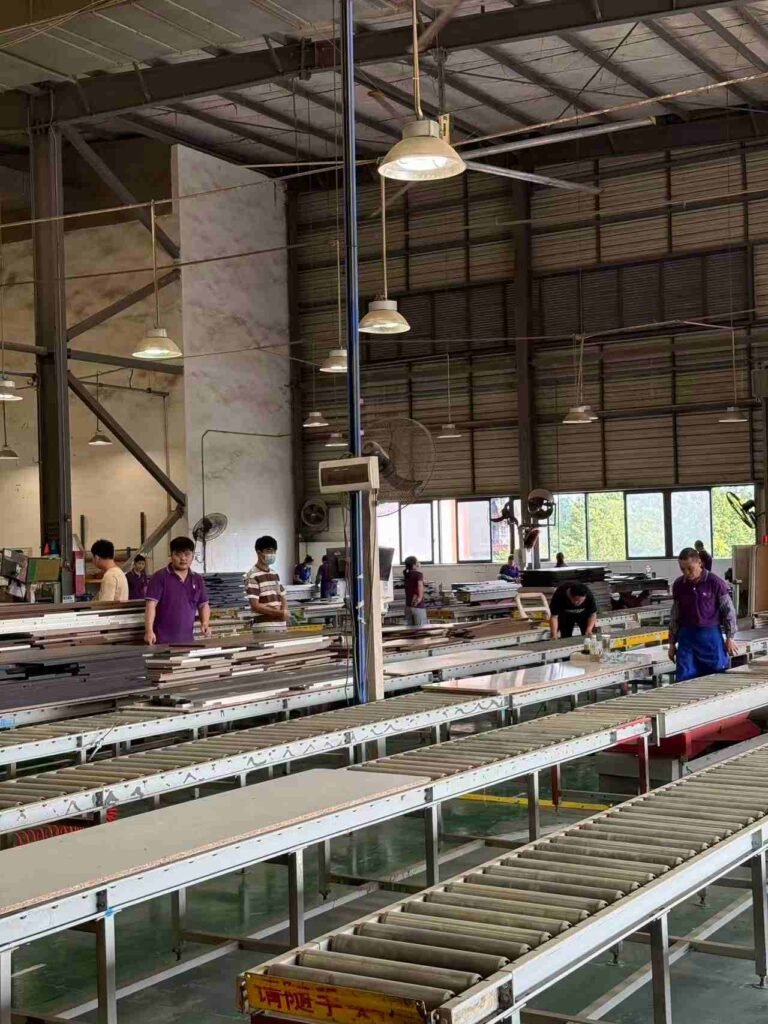
Automated cabinet panel conveyor production system
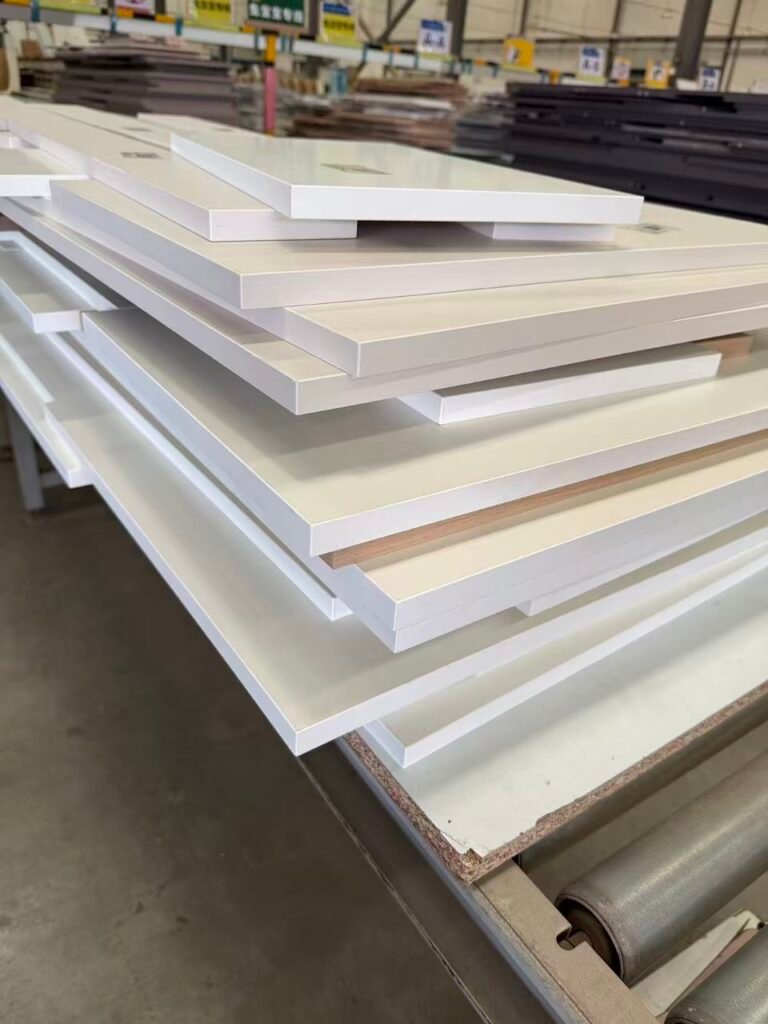
Finished edge banded cabinet panels inspection

A living room cabinet carcass isn’t a set of independent steps that happen to occur in sequence — cut, edge-band, drill, finish, fit hardware. It’s a chain where the tolerance from one stage directly determines whether the next stage can align correctly. A board slightly out of spec at the cutting stage doesn’t stay a cutting problem; it becomes a hinge-alignment or shelf-fit problem several stations later.

07

The Stations That Actually Determine Cabinet Quality

  • Raw material moisture content check
  • Panel cutting
  • Edge-banding
  • CNC drilling / hinge-cup machining
  • Surface finishing (paint, veneer, or laminate)
  • Hardware assembly
  • Quality inspection
  • Packing

08

Why the Problem You See Isn't Always at the Station You Think

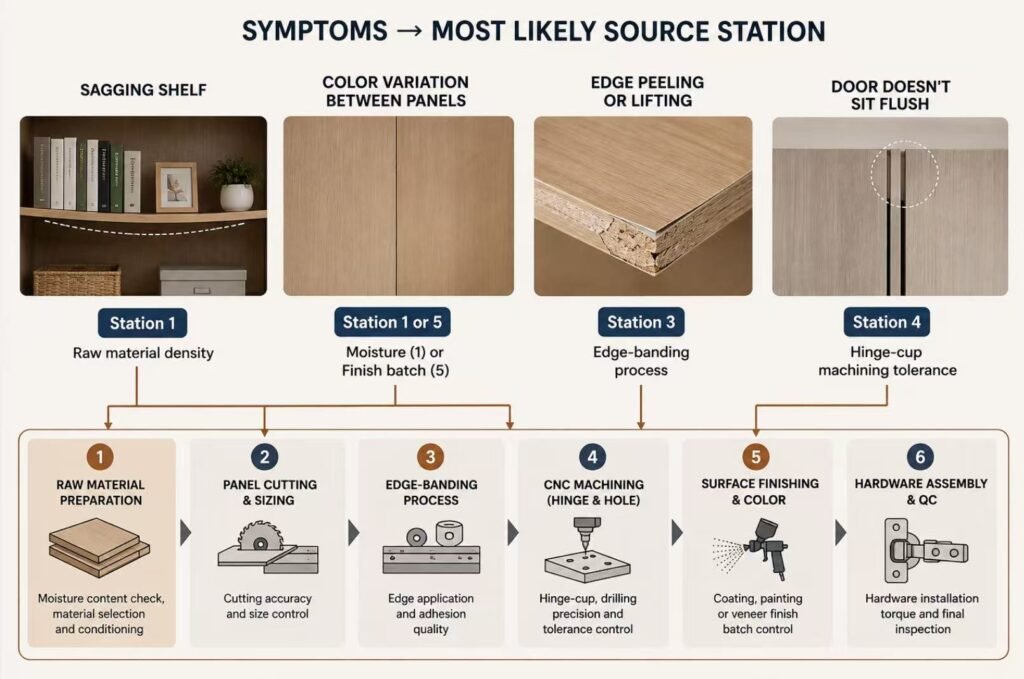
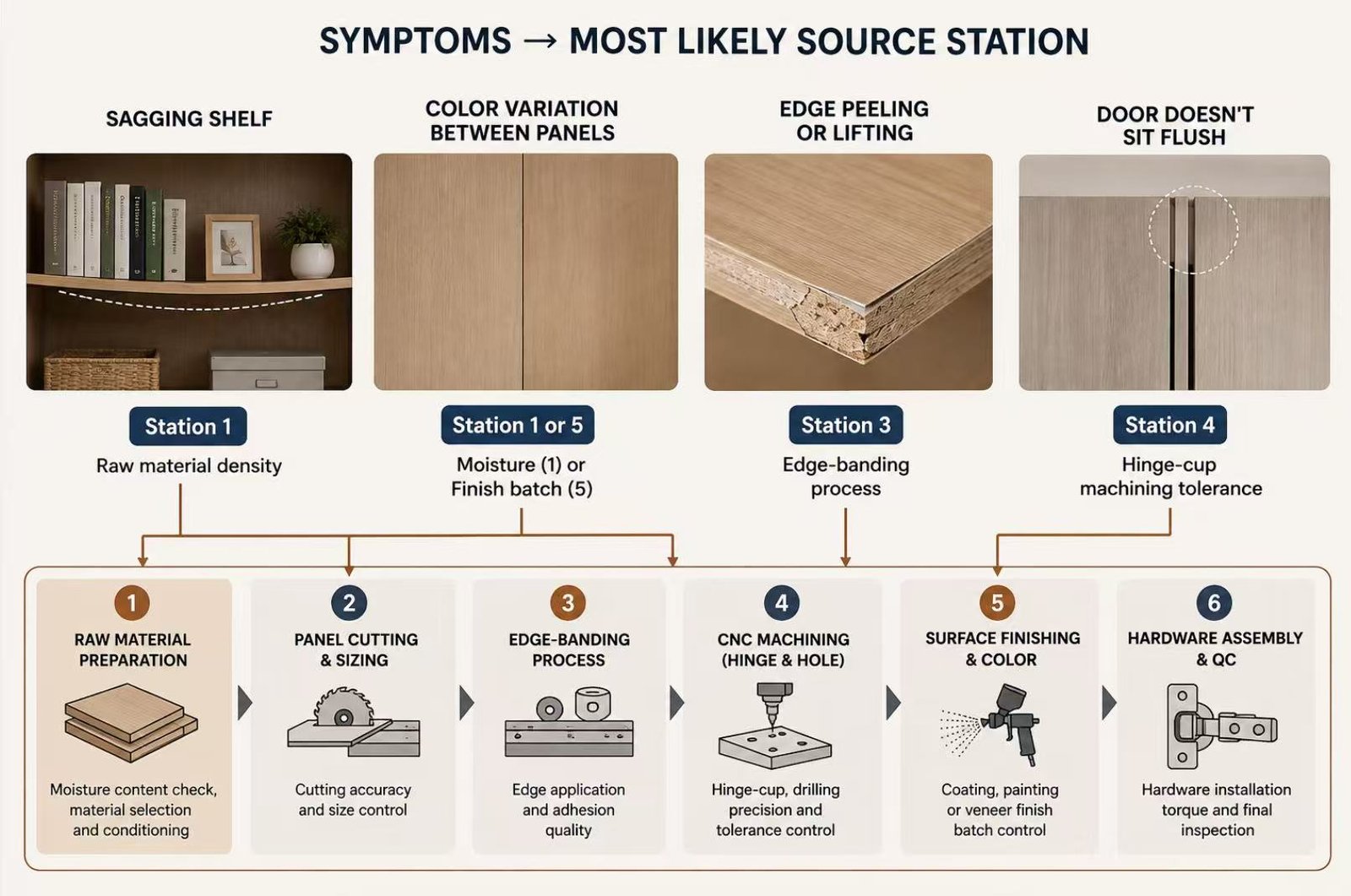
  • A sagging shelf looks like a load-capacity problem, but often traces back to raw material density at Station 1, not the shelf bracket at Station 6.
  • Visible color variation between panels looks like a finishing problem, but can originate from inconsistent moisture content at Station 1 causing uneven finish absorption at Station 5.
  • A cabinet door that won’t sit flush looks like a hardware adjustment problem, but is frequently a hinge-cup machining tolerance issue from Station 4.
  • Warping that appears months after installation looks like a delivery quality failure, but almost always traces back to inadequate moisture content control at Station 1 — a defect that takes months of humidity cycling to become visible.

09

Symptom-to-Station Diagnostic Table

Cabinet quality control process defect diagnosis
What you see vs. where it likely started
Visible symptomMost likely source station
Sagging shelfStation 1 — raw material density
Color variation between panelsStation 1 (moisture) or Station 5 (finish batch)
Edge peeling or liftingStation 3 — edge-banding process
Door doesn’t sit flushStation 4 — hinge-cup machining tolerance
Warping months after installationStation 1 — moisture content check
Noisy or stiff hinge operationStation 6 — hardware assembly torque

Why this matters when comparing suppliers — a supplier who can explain which station is responsible for a given defect is telling you they actually control their process station by station. A supplier who can only offer “we’ll replace the part” is treating the symptom, not the cause.

10

Why Climate Makes Station 1 More Important

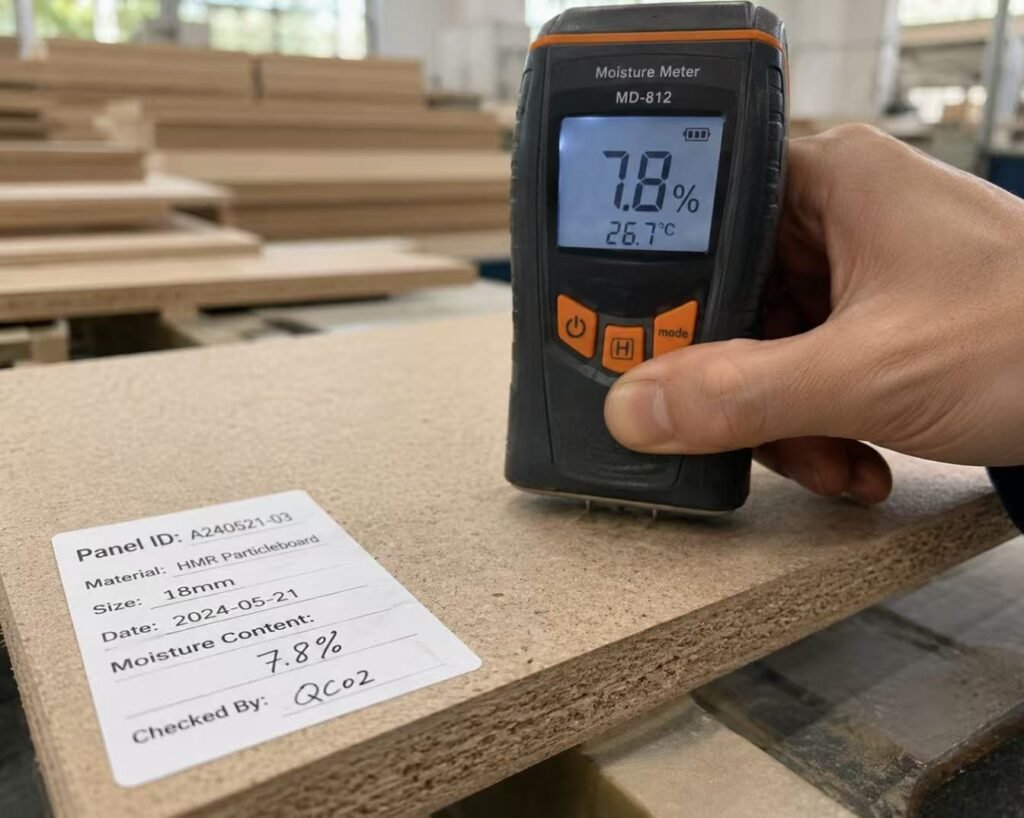
Cabinet board moisture content quality testing

Raw material moisture content matters more in Southeast Asia’s sustained humidity than almost anywhere else, since a board that passes a loose moisture threshold in a drier climate can still swell or warp under continuous tropical exposure — which is why humid-climate living room cabinetry should specify a moisture-resistant (MR/HMR) core grade with moisture content actually verified at Station 1, not assumed from a general classification. In hot, dry Middle East climates, sustained heat and direct sun exposure near large windows affect finish coatings and adhesives over time, making heat-stable finishing at Station 5 the more relevant checkpoint.

Part Three

Sourcing & Project Scale


11

What to Ask a Supplier's QC Process Before You Order

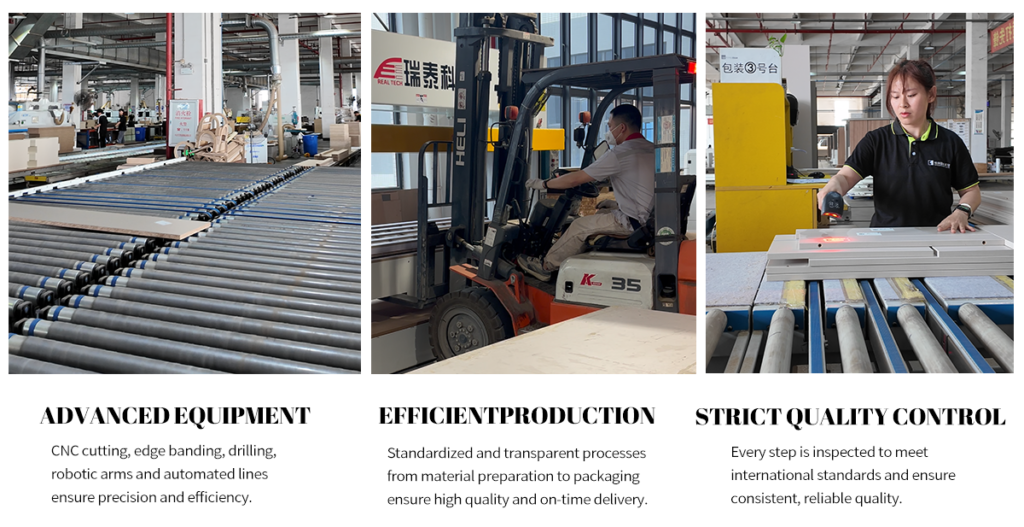
Advanced wardrobe factory production and quality control
  • Is moisture content checked and recorded at the raw material stage, not just at final inspection?
  • Can station-level inspection records be shown, not just a final QC pass/fail?
  • Is finish color checked against a retained physical master sample at each production run?

12

Living Room Storage for Villa & Hospitality Projects

On a single home, a station-level defect might mean one call-back. Across a villa development or hotel lobby/lounge project specifying the same storage design in multiple units or spaces, an uncontrolled tolerance at any one station compounds across every batch still in production — which is why station-by-station QC records, not just a final inspection, are what actually prevents inconsistency from surfacing across many units.

13

Sourcing a System Built With Station-Level Quality Control

At BoyceCasa, living room storage cabinets are tracked station by station — raw material moisture content, edge-banding, hinge-cup machining tolerance, and finish batch are each checked and recorded, not just verified at final inspection. For villa and hospitality projects, finish is checked against a retained master sample across every unit. This same standard applies across our kitchen cabinets, wardrobe, and interior doors lines.

Planning a custom living room storage system? Ask for station-level QC records, not just a final inspection report — they predict long-term consistency far better than a finished sample alone.


FAQS

A floating or wall-mounted cabinet keeps floor space clear, and a corner cabinet can recover otherwise unused space without adding to the room’s visual footprint.

An 18mm MDF shelf typically holds 20–25kg before visible sag over a 600–800mm span, dropping to 15–20kg over longer spans, while solid wood shelving of the same thickness holds meaningfully more.

Not necessarily. A door that won’t sit flush is often traced back to hinge-cup machining tolerance at the CNC drilling stage rather than a simple hardware adjustment issue.

Warping caused by inadequate moisture content control often doesn’t appear until months after installation, once the material has cycled through enough humidity exposure.

Ask whether they can show inspection records at each production stage, not just a final pass/fail result, and whether moisture content is checked and recorded at the raw material stage specifically.

Yes. Humid climates call for moisture-resistant (MR/HMR) core grades verified at the raw material stage, while hot, high-sun climates require heat-stable finishes, particularly near large windows.

Explore our Kitchen Cabinets and Wardrobe collections to see factory-direct cabinetry for villa and hotel projects, or contact our team for a project-specific consultation and quote.
Related reading:
Wardrobe Function and Organization: A Planning & Quality Guide →
L-Shaped Cupboard Design: Corner Storage That Actually Works
Modern Bedroom Wardrobe Color Combinations: A Project Guide
Kitchen Cabinet Materials in Singapore: Density, Moisture Resistance & What the Test Reports Actually Say

Let’s Discuss, Your Project.

Tell us about your project requirements and we’ll connect you with the right team. We typically respond within 24 hours on business days.

Call / WhatsApp
Offices
Located on Central Avenue, Nanhai District, Foshan City, Guangdong Province

Start a Conversation

Fill in your details and we’ll be in touch shortly.


Scroll to Top