Blog

Kitchen Cabinet Malaysia: What Actually Lasts in a Humid Climate

Kitchen layout clearance dimensions Malaysia

In the pursuit of personalized spaces and premium living, mass-produced furniture often falls short of capturing the true essence of a home.

As modern minimalism and light luxury styles continue to dominate global design trends, high-end custom furniture has become the absolute core of creating an ideal living space.However, the custom furniture market can be highly complex.

Bridging the gap between a stunning design blueprint and the final product involves navigating materials, hardware, and craftsmanship. Here is how to choose bespoke luxury furniture like a professional designer.

Most "kitchen cabinet Malaysia" content is either a top-10 supplier list or a design mood board. Neither answers the question that actually determines whether you're happy with your kitchen in five years: which materials hold up in Malaysia's climate, and how do you tell a supplier who can prove it from one who's just saying it?

If you're searching "kitchen cabinet Malaysia," you're probably weighing a few real worries at once: will this warp or swell given how humid it gets here? Am I paying for good materials or just a nice-looking showroom? Will the supplier I pick actually still be reachable in five years if something goes wrong? This guide answers all three directly — with material data, not just style inspiration.

Read time — 11 min
Scope — Materials · Layout · Hardware · Sourcing
Climate — Tropical, high humidity

Dry Kitchen vs. Wet Kitchen: Why One Material Choice Doesn't Fit Both

Malaysian homes commonly split the kitchen into two functional zones, and this single decision affects material choice more than anything else in this guide:
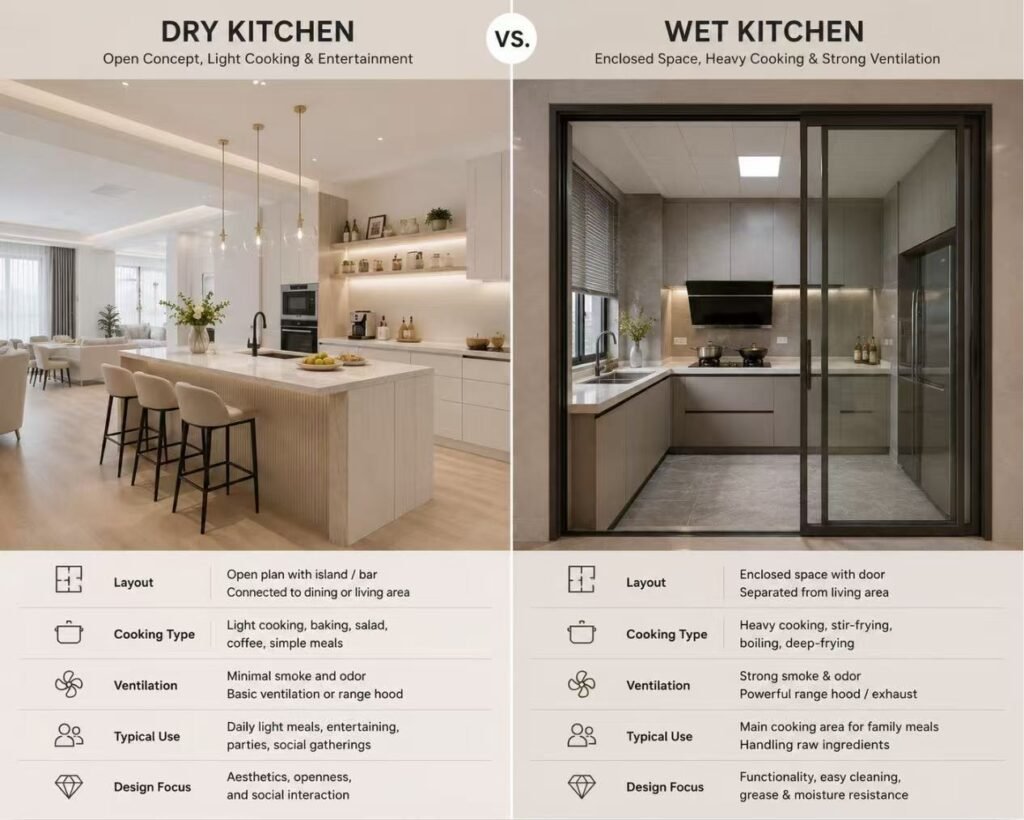
Dry kitchen versus wet kitchen Malaysia
  • Dry kitchen — used for light meal prep, coffee, and entertaining. Lower moisture and heat exposure means finishes like spray-painted panels and wood veneer can be prioritized for appearance without much durability trade-off.
  • Wet kitchen — used for the actual heavy cooking: wok-frying, steaming, boiling. This zone needs materials built for sustained moisture, heat, and grease exposure — melamine-faced chipboard (MFC) and glass are common choices specifically because they resist moisture and scratching and clean easily.

Why this matters for multi-country projects — a developer building across Southeast Asia, the Middle East, and beyond will encounter all of these metric-vs-imperial conventions depending on which market’s building supply chain and codes a given project follows. Specifying “standard width” without naming the regional standard is a common source of a mismatched door order, since a 32-inch US door and an 826mm European door are close but not interchangeable, and neither matches a 762mm UK door.

Material Comparison: The Data Most Malaysia-Focused Content Leaves Out

Kitchen cabinet core materials compared
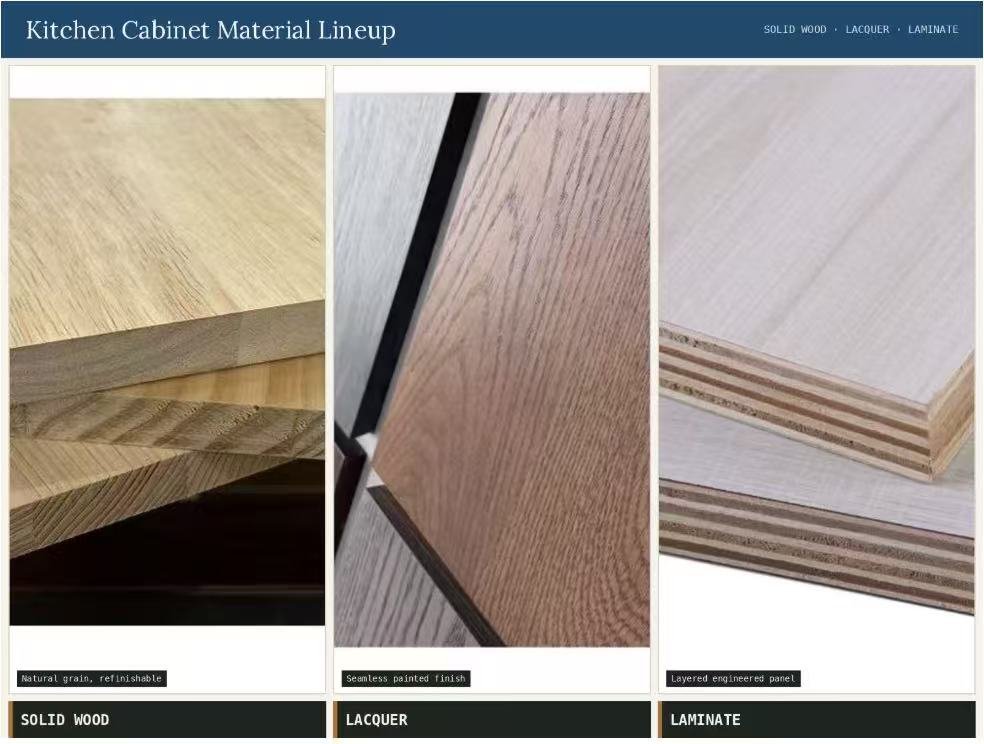
MaterialMoisture performanceBest zoneRelative cost
Solid woodWeak — expands/contracts in sustained humidityDry kitchen, low-moisture areasHighest
MFC (melamine-faced chipboard)Good — moisture and scratch resistantWet kitchen, sink/hob runsMid
Glass-front panelsGood, but requires regular cleaning to avoid grease buildupWet kitchen (with maintenance)Mid-high
Spray-painted (lacquer) finishModerate — depends on coat quality and substrateDry kitchen, display areasMid-high
Solid wood lacquer and laminate cabinets compared

Beyond the finish layer, the core panel underneath matters just as much — a moisture-resistant (MR) grade core behind a nice finish outperforms a standard core behind an identical-looking finish, and this distinction is almost never mentioned in consumer-facing Malaysian kitchen content.

Popular Kitchen Layouts in Malaysia, With the Dimensions Content Usually Skips

I-shaped, L-shaped, U-shaped, and island layouts are the four most common configurations in Malaysian homes — each suited to a different kitchen size and traffic pattern:
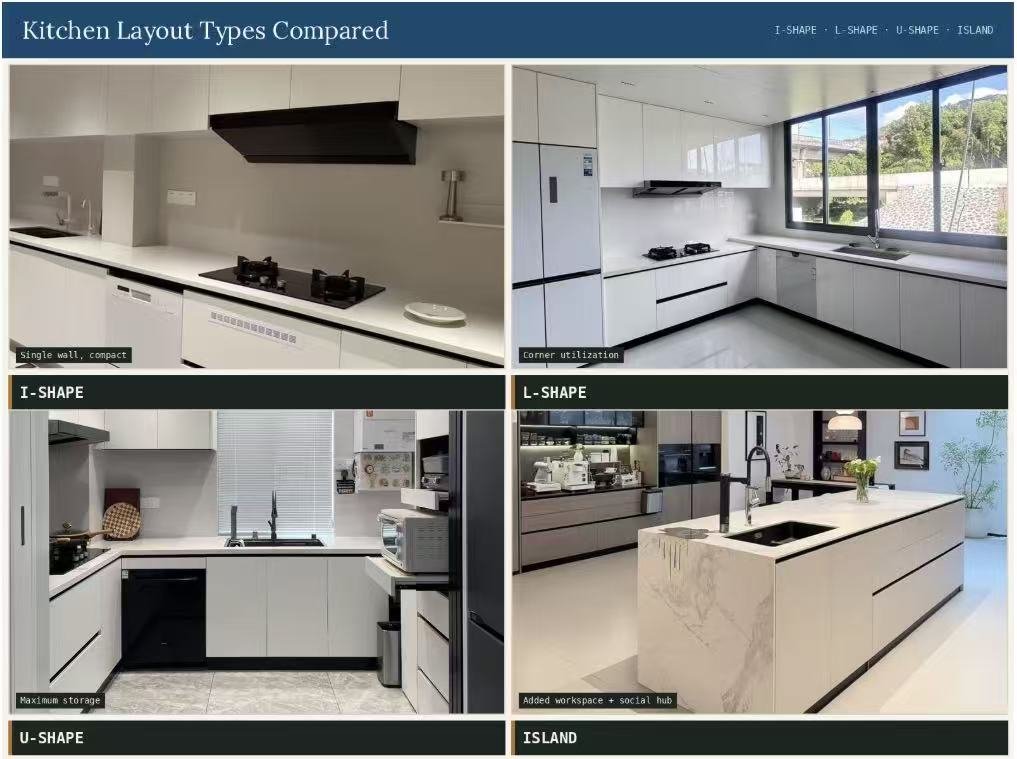
Kitchen layout clearance dimensions Malaysia
Layout type and typical clearance
LayoutBest forMinimum walkway clearance
I-shaped (single wall)Compact kitchens, apartments900–1000mm
L-shapedMedium kitchens, corner utilization1000–1100mm
U-shapedLarger kitchens needing maximum storage1100–1200mm
IslandLarger kitchens, added workspace and social focal point1000mm minimum around the island perimeter

Most layout guides describe these shapes without ever giving the clearance figures that determine whether the finished kitchen actually feels comfortable to move around in — a detail worth confirming against your actual floor plan before committing to a layout, not after cabinets are installed.
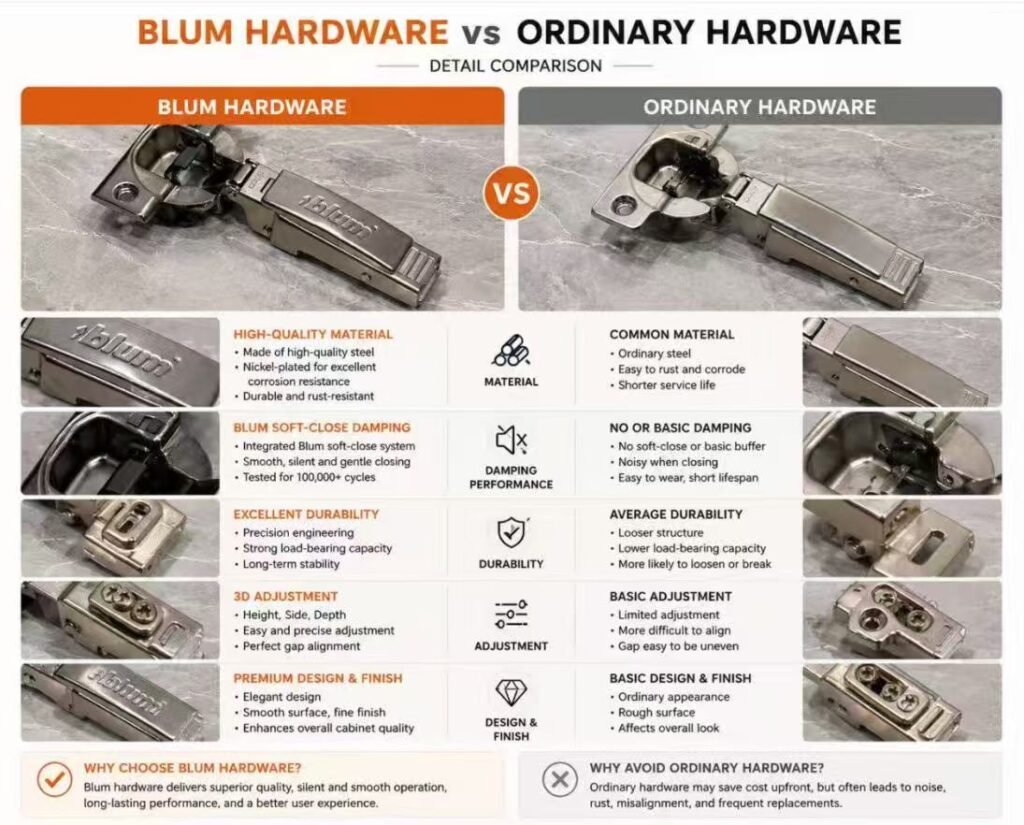
Hardware: The Questions Behind "Soft-Close Is a Bare Minimum"

Soft-close hinges and drawers are now standard expectations, but “soft-close” alone doesn’t tell you how long that mechanism will actually last:

Branded versus generic cabinet hinge hardware
  • Cycle rating — branded hardware (Blum, Hettich, and similar) is typically rated 50,000+ cycles; generic unbranded hardware is often rated far lower, closer to 15,000–25,000 cycles.
  • Drawer slide type — full-extension, soft-close runners hold up better under daily use than basic side-mounted runners, particularly in a wet kitchen where drawers get opened with wet or greasy hands multiple times a day.

A kitchen can look identical in a showroom with either hardware tier installed — the difference only becomes obvious after a few years of daily use, which is exactly why it’s worth asking about directly before ordering, not assuming from the finish alone.

Cabinet Color: A Quick, Honest Answer

White remains the most consistently popular kitchen cabinet color in Malaysia, largely because it reads as clean and spacious in both large and small kitchens. Darker tones add warmth in larger, well-lit kitchens but can feel heavy in smaller or dimly lit ones — the same principle that applies to wardrobe and cabinet color choices generally. This is a real decision, but a secondary one compared to the material and hardware choices above, which is why it gets one section here rather than the whole guide.

How to Actually Evaluate a Kitchen Cabinet Supplier in Malaysia

Most “top kitchen cabinet suppliers in Malaysia” content online is a directory — a list of company names with a sentence or two of self-description, ranked with no stated evaluation criteria. That format tells you who exists, not who’s actually reliable. Here’s what’s worth asking for instead of relying on a ranked list:

  1. A material test certificate — density, moisture resistance, and formaldehyde emission grade for the specific board being quoted, not a general claim on a brochure.
  2. A named core panel grade — “moisture-resistant” should come with an actual grade or standard reference, not just the phrase itself.
  3. Hardware brand and cycle rating — a specific answer, not “premium soft-close hardware” as a generic descriptor.
  4. Batch consistency process — relevant if you’re ordering across multiple units or rooms; ask whether finish is checked against a retained master sample.
  5. After-installation support — what happens if a hinge fails or a panel needs replacement in year three, and whether that support is still available from the same supplier at that point.

Why this matters more than a ranking — a supplier ranked #3 on a top-10 list with verifiable answers to all five questions above is a safer choice than a #1-ranked supplier who can’t produce a test certificate on request. The ranking tells you about marketing reach; these five questions tell you about what you’ll actually be living with.

Sourcing Kitchen Cabinets for Malaysian Villa & Hospitality Projects

At BoyceCasa, kitchen cabinet material and core panel grade are specified against the actual moisture exposure of each zone — wet kitchen and dry kitchen treated as distinct specifications, not one material applied throughout — and backed by test certificates provided before production. Hardware is specified with a stated cycle rating as standard, and for multi-unit projects, finish is checked against a retained master sample across every unit. This same standard applies across our kitchen cabinets, wardrobe, and interior doors lines for villa and hospitality projects across Malaysia and the wider region.

Comparing kitchen cabinet suppliers in Malaysia? Ask for the material test certificate and hardware cycle rating before comparing finish photos — those two answers predict long-term performance far better than a ranking.


FAQS

What is the best kitchen cabinet material for Malaysia's climate?

Melamine-faced chipboard (MFC) and glass panels are generally better suited to Malaysia's humid climate for wet kitchen zones, since they resist moisture and scratching, while solid wood and spray-painted finishes are better reserved for lower-moisture dry kitchen areas.

A dry kitchen is used for light meal prep and entertaining with lower moisture exposure, while a wet kitchen handles heavy daily cooking and needs materials built to withstand sustained moisture, heat, and grease.

Ask for the specific hardware brand and cycle rating. Branded hardware is typically rated 50,000+ cycles, while generic hardware is often rated closer to 15,000–25,000 cycles, even when both are marketed as "soft-close."

White remains the most consistently popular choice, as it reads as clean and spacious in both large and small kitchens, though darker tones are increasingly used in larger, well-lit kitchens for a warmer feel.

Treat it as a starting list of names, not a substitute for due diligence. A supplier's actual reliability is better judged by whether they can provide a material test certificate, a specific hardware cycle rating, and a clear after-installation support policy, rather than their position on a ranked list.

Yes. Batch-to-batch finish consistency and confirmed material specifications matter significantly more across a multi-unit villa or hospitality project than for a single kitchen, since a mismatch becomes visible across many identical units rather than one.

Explore our Kitchen Cabinets and Wardrobe collections to see factory-direct cabinetry for villa and hotel projects, or contact our team for a project-specific consultation and quote.
Related reading:
Typical Door Dimensions & Standard Door Height (mm): A Complete Guide
Door Rough Opening Size: The Complete Chart & Sourcing Guide
Windows and Doors: A Complete Buying & Sourcing Guide
Window and Door Materials
Aluminium Doors & Windows for Hot Climate Projects
Kitchen Cabinets Singapore: A Sourcing Guide for Developers & Interior Designers
Kitchen Cabinet Materials in Singapore: Density, Moisture Resistance & What the Test Reports Actually Say
HDB & Condo Kitchen Layouts: What Actually Goes Wrong at Installation


Let’s Discuss, Your Project.

Tell us about your project requirements and we’ll connect you with the right team. We typically respond within 24 hours on business days.

Call / WhatsApp
Offices
Located on Central Avenue, Nanhai District, Foshan City, Guangdong Province

Start a Conversation

Fill in your details and we’ll be in touch shortly.


Scroll to Top