Light Grey vs. Dark Grey vs. Warm Grey: Three Different Decisions, Not One
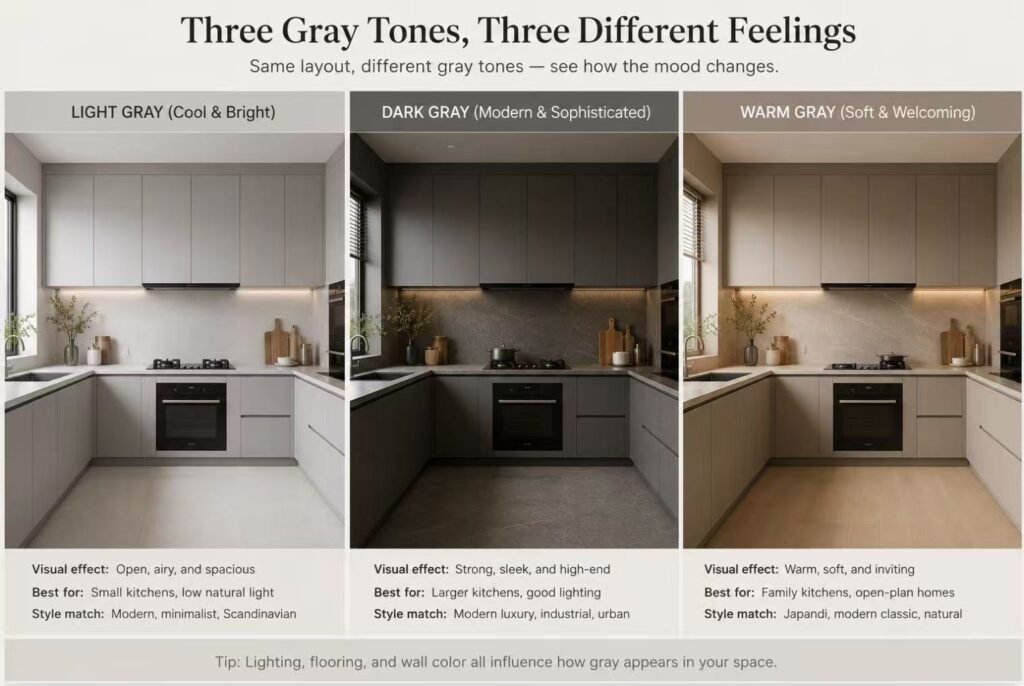
"Grey" isn't one color decision — it's three, each suited to a different situation:
Light grey — behaves close to white in a small space, keeping the room feeling open, while offering slightly more forgiveness against everyday marks than pure white.Dark grey — reads as dramatic and grounded, but works best in larger kitchens with strong ambient or natural light; in a small or dim kitchen, it can make the space feel more enclosed.Warm grey — a grey with a red or brown undertone, which pairs well with wood tones and reads as cozy rather than clinical, largely independent of the room's specific style.
Choosing between these isn’t primarily a style decision — it’s a room-size and lighting decision first, with style preference narrowing the choice afterward.
Two-Tone Layouts: Why Upper White + Lower Grey Isn't Just a Style Choice
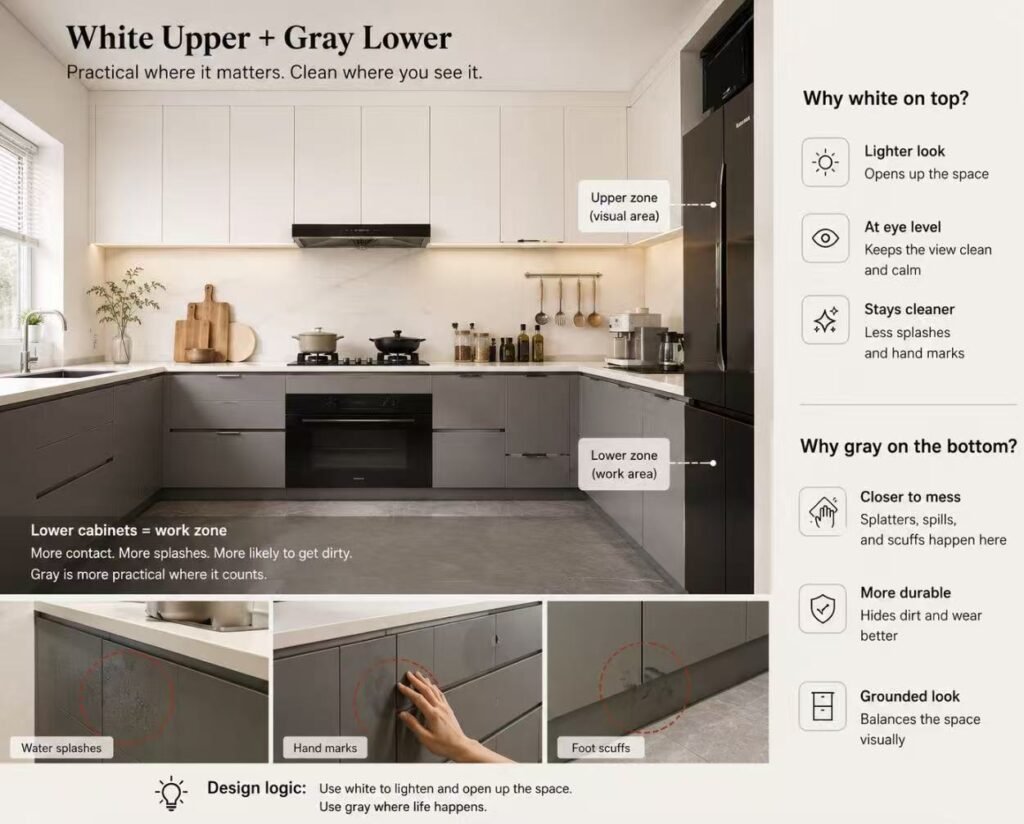
The white-upper, grey-lower combination shows up constantly in kitchen design content, usually described purely as an aesthetic trend. There’s a practical logic behind why it holds up well over time: lower cabinets take the daily impact of spills, grease, and hand contact, while upper cabinets are touched far less often. Grey conceals marks and smudges more effectively than white in exactly the zone that needs it most, while white above keeps the room feeling bright rather than heavy. This is a durability-driven pairing that happens to also look good — not the reverse.
Finish Type Comparison: What Actually Determines Maintenance Difficulty
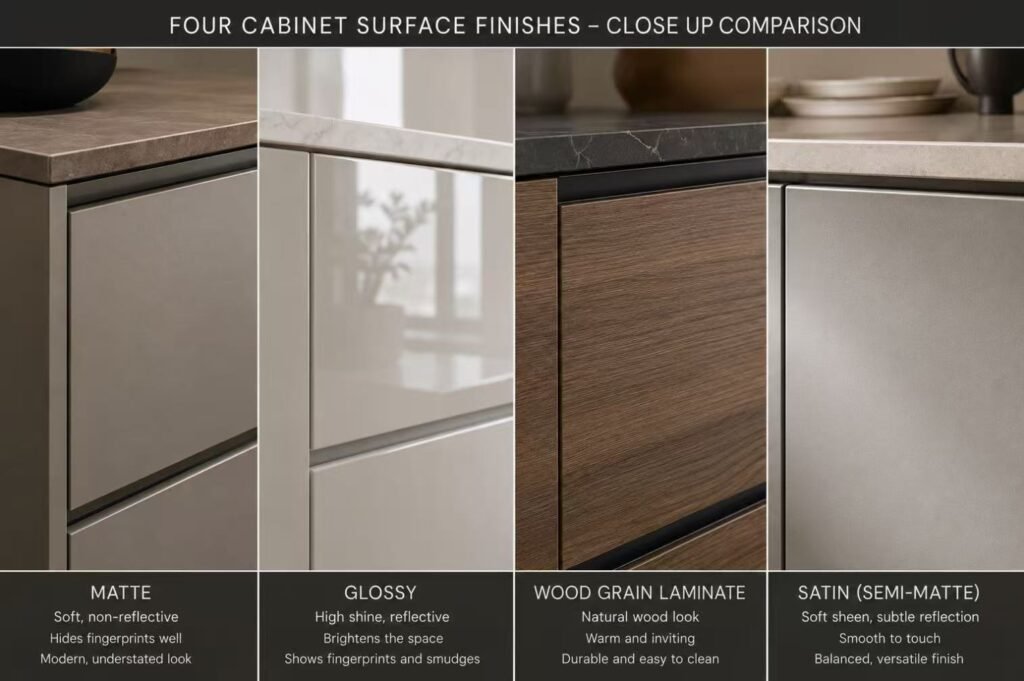
Grey/white cabinet finish types compared| Finish | Fingerprint visibility | Scratch resistance | Cleaning difficulty |
|---|
| Matte lacquer | Low — diffuses light, hides marks well | Moderate — shows scuffs more than gloss | Easy, forgiving of streaks |
| High-gloss lacquer/acrylic | High — reflective surface shows every mark | Good, but scratches are more visible against the shine | Requires more frequent wiping to avoid streaking |
| Textured/wood-grain laminate | Very low — texture breaks up light reflection | Good | Easy, marks blend into the texture |
| Satin/semi-matte | Moderate | Good | Balanced — a common middle-ground choice |
The finish type generally matters more for day-to-day maintenance than the exact grey tone chosen — a textured or matte finish in either light or dark grey will show less daily wear than a high-gloss finish in the same color.
Why Grey and White Reads Cooler in Hot, Humid Climates
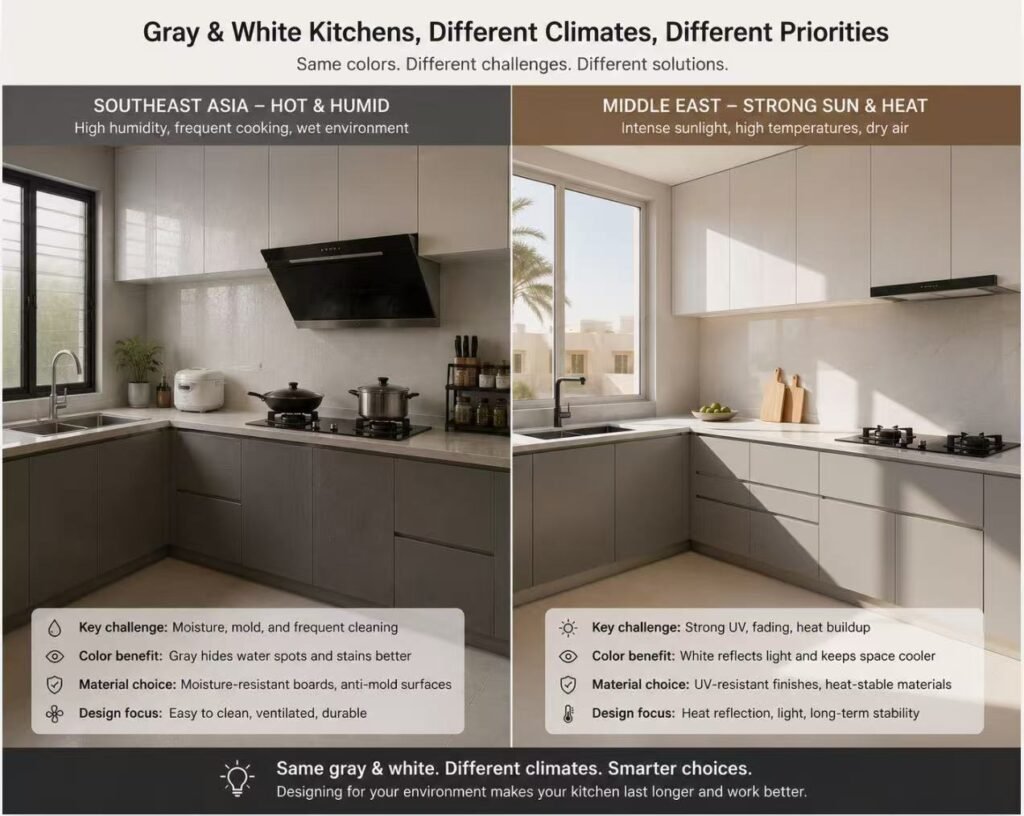
Grey and white surfaces reflect more visible light than warm or dark tones, which contributes to a room reading visually “cooler” even before accounting for actual temperature — a genuinely relevant factor in Southeast Asian and Middle Eastern kitchens, where both the ambient heat and the visual weight of a room affect how comfortable it feels to work in. This is one reason grey-and-white combinations have become common across both regions, though the two climates apply the logic slightly differently:
- Southeast Asia (humid) — lighter grey and white tones help counteract the visually “heavy” feeling of a humid, often lower-light kitchen space.
- Middle East (hot, dry, high sun exposure) — grey and white surfaces reduce visual heat load in kitchens with large windows or strong natural light, without the maintenance sensitivity of a pure, unbroken white.
Color Retention: The Data Most Guides Never Show You
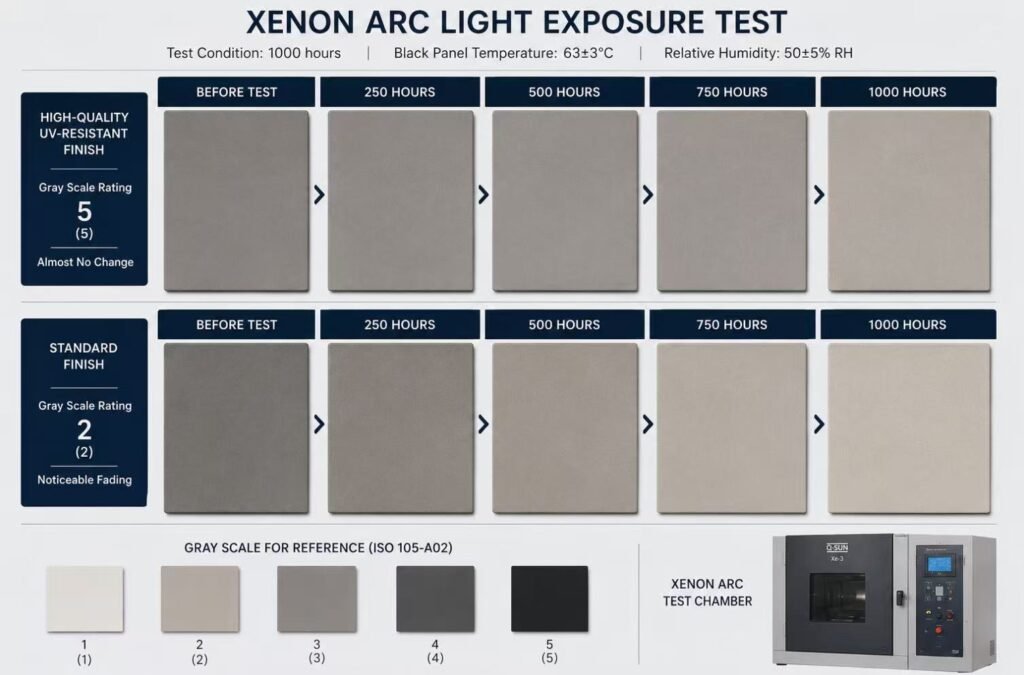
“Timeless” and “won’t look dated” are common claims about grey and white cabinets, but color retention is actually a testable, measurable property, not just a style opinion. Painted and lacquered surfaces are commonly evaluated using accelerated light-fastness testing — exposing a sample to a xenon-arc lamp calibrated to replicate the UV spectrum of natural daylight, then comparing the color change against a reference scale (such as the widely used Blue Wool Scale, rated 1 to 8, where a higher number indicates better resistance to fading).
The question worth asking a supplier — “what light-fastness or UV-fade test has this finish been evaluated against, and what was the result?” A supplier who can answer this with a specific test method and rating is telling you the finish has actually been verified, not just marketed as durable. A vague answer is itself informative.
Matching Countertops & Backsplash Without the Trend Trap
Grey and white cabinets pair well with a wide range of countertop and backsplash materials, which is part of their appeal — but the pairing should be chosen for longevity, not just the current trend. Veined marble or quartz countertops and simple subway tile backsplashes have stayed consistently popular alongside grey-and-white cabinetry for years, generally outlasting more novelty-driven pairings like heavily patterned tile combinations, which tend to date a kitchen faster than the cabinet color itself.
Keeping Grey and White Consistent Across a Multi-Unit Project
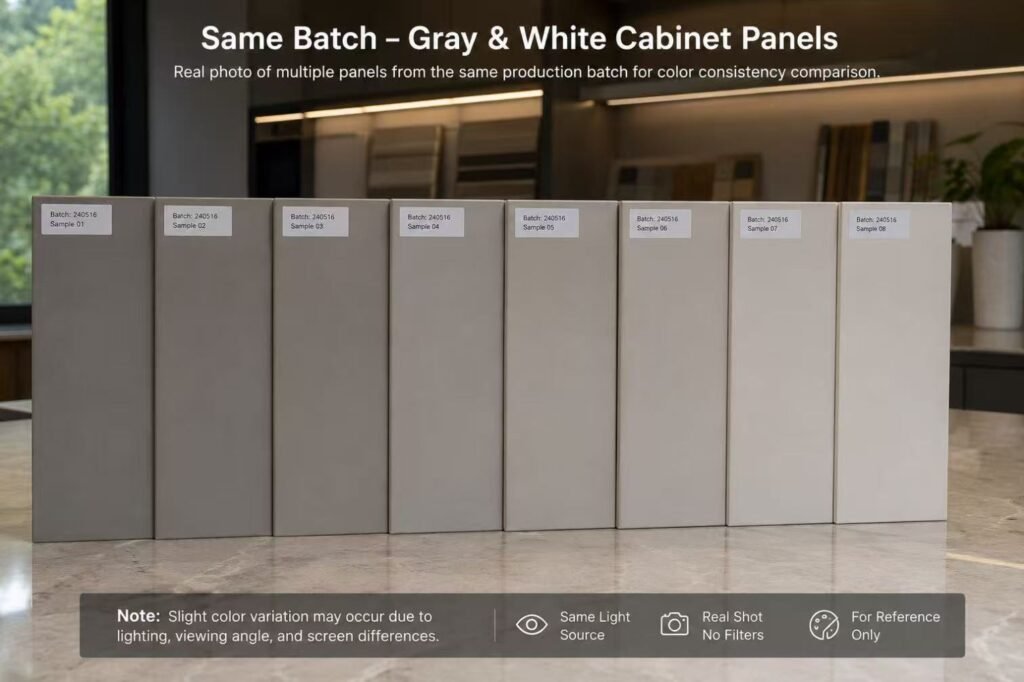
On a single kitchen, a slight color variation between panels is rarely noticed. Across a villa development or hotel project with the same grey-and-white specification repeated in every unit, batch-to-batch color drift becomes a real and visible risk — especially with dark grey and pure white, both of which show subtle color shifts more readily than mid-tone colors. Locking the specification against a retained physical master sample, checked at every production batch, is the standard way to prevent this rather than relying on a color code or photo reference alone.
Sourcing Cabinets With Verified Color Consistency
At BoyceCasa, grey and white finish specifications are backed by light-fastness test data and checked against a retained master sample across every production batch — so a project’s grey doesn’t drift between unit one and unit fifty. This same standard applies across our kitchen cabinets, wardrobe, and interior doors lines, informed by the same climate-driven material thinking covered in our Kitchen Cabinet Materials in Singapore guide.
Specifying grey and white cabinetry for a villa or multi-unit project? Ask for the light-fastness test rating and confirm the batch-matching process before finalizing the color — not just the paint swatch.
FAQS
Explore our Kitchen Cabinets and Wardrobe collections to see factory-direct cabinetry for villa and hotel projects, or contact our team for a project-specific consultation and quote.
Related reading:
Kitchen Island Dimensions: Sizing & Clearance Guide
Kitchen Cabinet Materials in Singapore: Density, Moisture Resistance & What the Test Reports Actually Say
Best Material for Kitchen Cabinets: Full Comparison
L-Shaped Cupboard Design: Corner Storage That Actually Works