Blog

Aluminium Window Design: What Every Color and Style Choice Actually Costs You in Performance

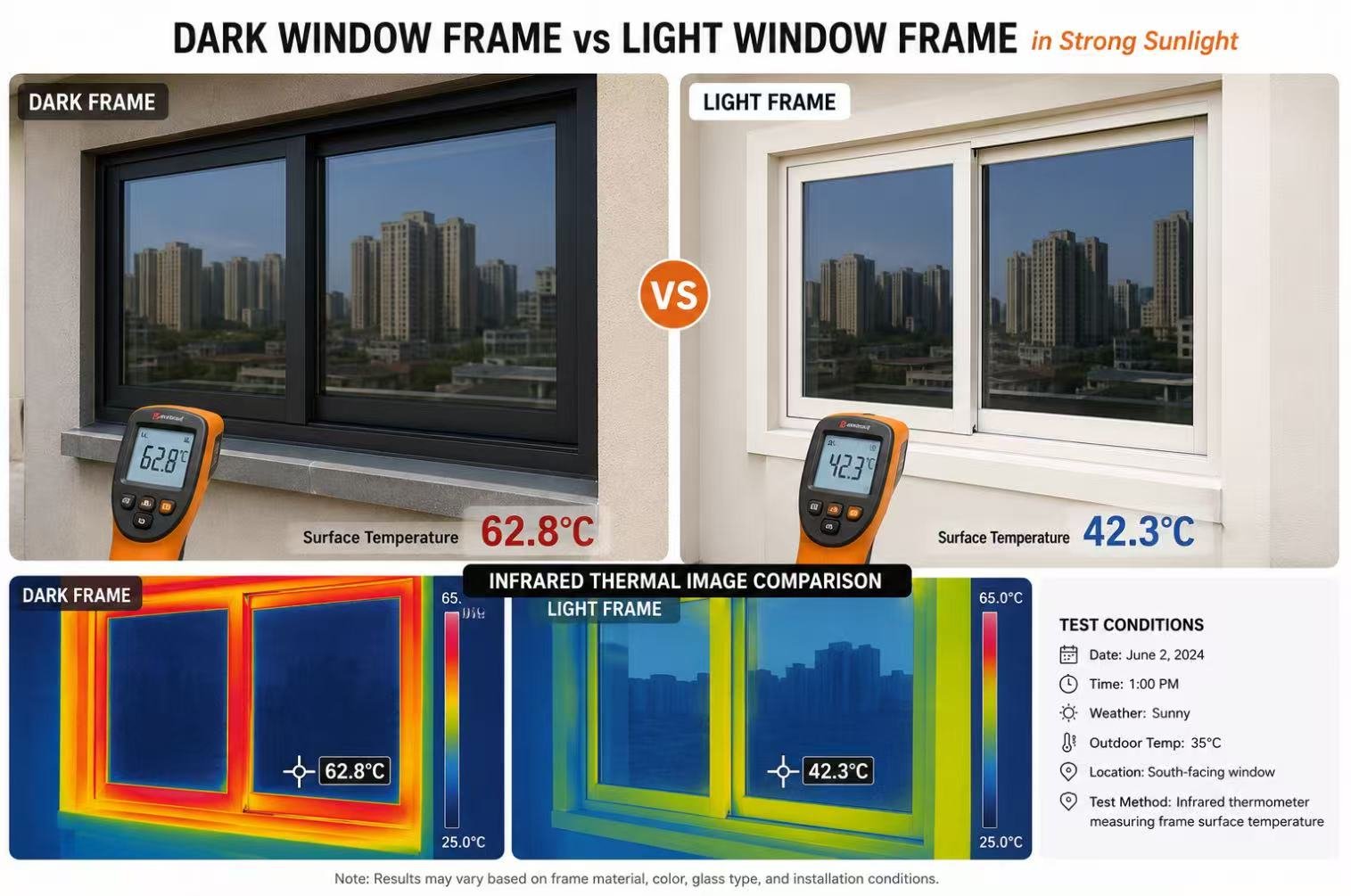
Dark versus light aluminium window frame color

In the pursuit of personalized spaces and premium living, mass-produced furniture often falls short of capturing the true essence of a home.

As modern minimalism and light luxury styles continue to dominate global design trends, high-end custom furniture has become the absolute core of creating an ideal living space.However, the custom furniture market can be highly complex.

Bridging the gap between a stunning design blueprint and the final product involves navigating materials, hardware, and craftsmanship. Here is how to choose bespoke luxury furniture like a professional designer.

Every design guide shows you the swatch card. Almost none tell you what that swatch actually does once it's installed under Gulf sun or through a Southeast Asian monsoon season. This guide puts the design decision and the performance consequence side by side.

If you're choosing an aluminium window design, you've probably already fallen in love with a look — a charcoal frame, a slim minimalist profile, a particular opening style. That's a reasonable starting point. What most design guides don't tell you is what each of those choices actually does once it's living through real heat, real salt air, or a real sandstorm. This guide answers that directly, choice by choice.

Read time — 10 min
Covers — Color · Finish · Window type · Profile width
Climate scope — Middle East · Southeast Asia

Frame Color: The Trade-Off Nobody Puts on the Swatch Card

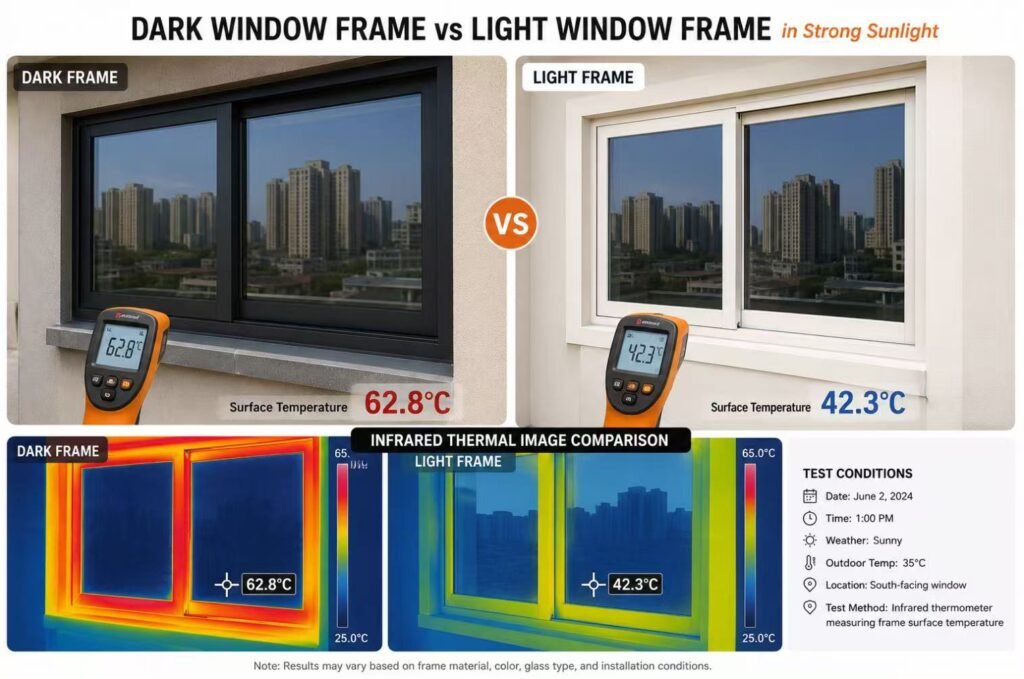
Charcoal and warm grey frames are currently the most requested colors, and for good reason — they read as modern and pair well with both stone and timber exteriors. What the swatch card doesn't show you is thermal behavior:
Dark versus light aluminium window frame color
  • Dark frames absorb significantly more solar heat than light ones, which can raise frame surface temperature considerably under direct sun — a real factor in Gulf climates where frames face sustained, intense exposure for most of the day.
  • Light and white frames reflect more heat, keeping surface temperatures lower, which matters more for the frame’s own thermal expansion and seal longevity than most buyers realize.

This doesn’t mean avoid dark frames — it means pair a dark frame with a thermal break sized for the actual heat load, not a generic spec. A charcoal frame with an appropriately wide thermal break performs very differently from the same color with a minimal one.

Powder Coating vs. Anodizing: Which Finish Survives Coastal Salt Air

Finish comparison for coastal and humid climates
FinishColor rangeSalt-air performanceTypical warranty
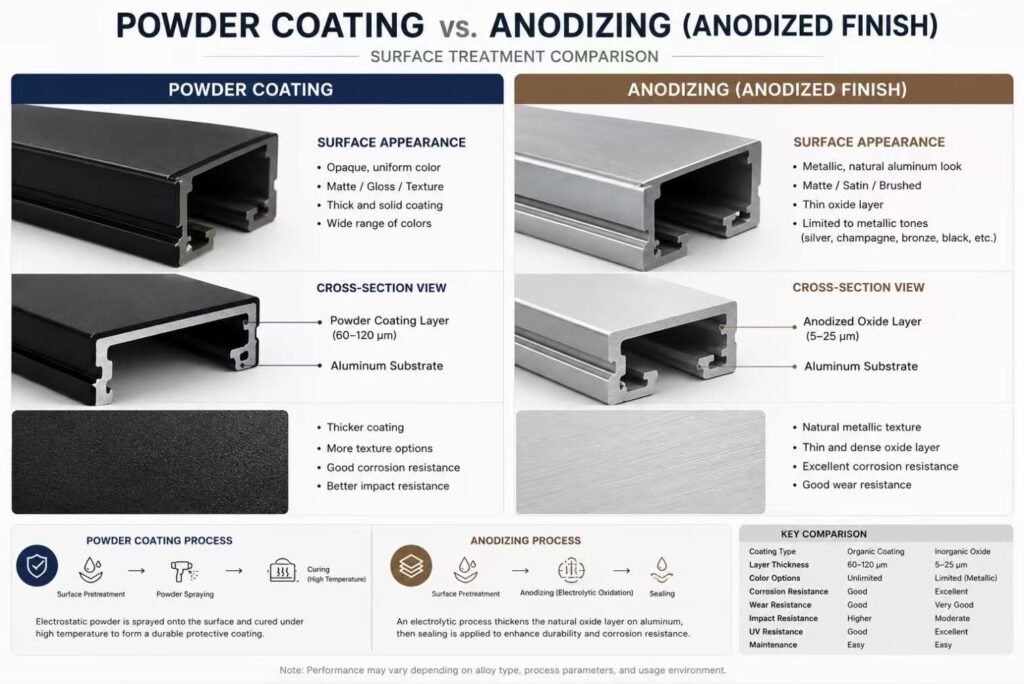
Powder coatingVery wide — 200+ RAL colors, metallics, wood grainsGood, with coastal-grade formulation tested to 1,000–2,000 hrs salt spray15–25 years against peeling, fading
AnodizingNarrower — natural metallic tones, limited color rangeExcellent — the anodized layer is part of the metal itself, not a coatingLong-term, thickness-dependent
Powder coating versus anodized aluminium finish

Powder coating wins on design flexibility — it's how you get a true charcoal or a bold statement color. Anodizing wins on raw longevity in aggressive coastal environments, since there's no separate coating layer that can eventually chip or peel. For most Southeast Asian and Middle East coastal villa projects, a coastal-grade powder coat is the practical middle ground — full design flexibility, tested salt-spray performance.

Window Type by Climate Function, Not Just Look

Window types matched to climate demands
TypeDesign appealClimate performance note
CasementClean lines, unobstructed views when openBest air infiltration test scores of common types; strong sealing against wind-driven rain
SlidingMinimalist, space-savingTrack can trap sand/dust in Gulf climates; needs sealed, anti-dust track detailing
Tilt-and-turnDual-function, European aestheticStrong sealing in tilt mode; good for controlled ventilation without full opening
LouvreTropical, resort aestheticExcellent airflow even closed; weakest sealing performance — not ideal for bedrooms or sound-sensitive rooms

The design appeal of a window type and its climate suitability are two separate questions — a louvre window's tropical look is genuinely well-suited to Southeast Asian ventilation needs, but the same open-blade structure that gives it that airflow also limits its sealing performance, a trade-off worth deciding on consciously rather than by aesthetics alone.
The Slim Profile Trend: Where It Helps and Where It's a Liability

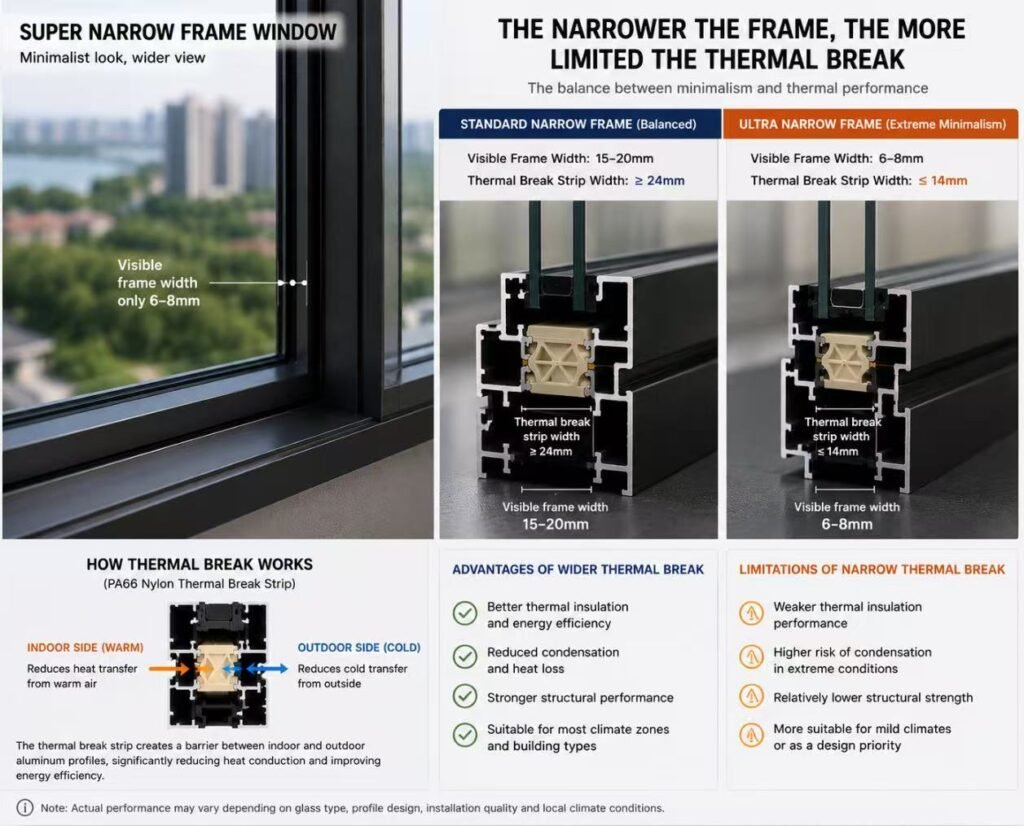
Ultra-narrow “slimline” frames are the dominant design trend right now, prized for maximizing glass area and minimizing visual bulk. The trade-off rarely mentioned alongside the trend: a narrower frame profile leaves less physical room for the thermal break itself.

Slim aluminium window frame thermal break profile

What this means in practice — a slim profile pursued without checking the thermal break width can quietly undercut the energy performance the aluminium system was otherwise specified to deliver. For large openings in hot climates, it’s worth confirming the thermal break dimension specifically, not just the overall frame width, before committing to the slimmest available profile.

Standard Performance Numbers Worth Asking For

Design conversations tend to stay in style language — “sleek,” “modern,” “minimalist.” These are the actual numbers worth asking a supplier for instead:

Performance specifications to request
MetricWhat to ask forWhy it matters
Wind pressure resistanceRated in Pa (e.g., 2000 Pa)Determines suitability for high-wind coastal or storm-exposed sites
Sound insulationRated in dB (e.g., 25 dB reduction)Relevant for urban, road-facing, or hospitality projects needing quiet rooms
Color/coating retentionWarranty period against fading (e.g., 15–25+ years)Predicts how the design will actually look a decade after installation, not on day one
Salt spray test ratingHours tested under ASTM B117 or ISO 9227The real predictor of coastal corrosion resistance, not the color name

Matching Design Language to Villa Architecture in Southeast Asia vs. the Middle East

The same “aluminium window design” question gets a different answer depending on regional architectural language:

Middle East versus Southeast Asia villa window design
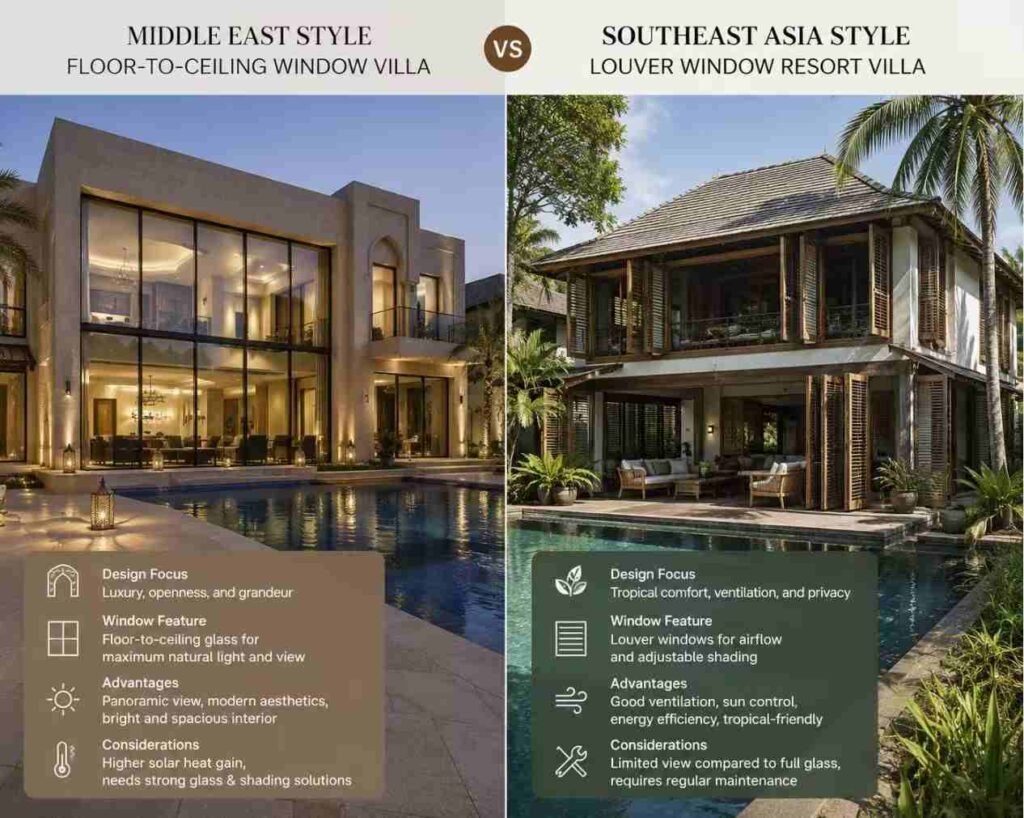
  • Middle East villas tend toward large, floor-to-ceiling glazed openings with dark, slim-profile frames — a design language that reads as contemporary and pairs well with stone facades, provided the thermal break and glazing package are sized for the actual heat load, not just the look.
  • Southeast Asian resort and villa design more often favors a mix of louvre and casement openings with lighter frame tones, balancing shading, ventilation, and monsoon-rain resistance over a single large glazed statement.

Neither preference is wrong — they reflect genuinely different climate priorities, and a design language borrowed wholesale from one region into the other often needs real adjustment, not just a frame color swap.

Sourcing a Design That Performs, Not Just Photographs Well

At BoyceCasa, frame color, coating type, and window system are specified together against the project’s actual climate — thermal break width, salt-spray rating, and wind pressure resistance confirmed before the design is locked, not treated as separate conversations. This is covered in more technical depth in our aluminium doors and windows for hot climate projects guide. This same design-meets-performance approach extends across our window, interior doors, and kitchen cabinets lines.

Choosing an aluminium window design for a villa or hospitality project? Confirm the thermal break width and salt-spray rating before finalizing the color and profile — the swatch card won’t tell you either number.


FAQS

Do dark aluminium window frames perform worse in hot climates?

Dark frames absorb more solar heat and can reach higher surface temperatures than light frames, but this is manageable with an appropriately sized thermal break rather than a reason to avoid dark colors altogether.

Anodizing generally offers superior long-term corrosion resistance since the finish is part of the metal itself, while powder coating offers far greater color and design flexibility with good coastal performance when tested to a recognized salt-spray standard.

They can, if the thermal break width is reduced along with the overall frame width. It's worth confirming the specific thermal break dimension, not just the frame's slim appearance, before specifying the narrowest available profile for a large or high-heat-exposure opening.

Casement windows generally perform best against wind-driven sand and dust due to their compression seal, while sliding windows need sealed, anti-dust track detailing to prevent sand ingress affecting smooth operation.

This depends on the specific site's wind exposure data, but a rating in the range of 2000 Pa or higher is commonly specified for coastal or storm-exposed residential projects — confirm the actual site requirement with a structural engineer rather than assuming a standard figure applies.

Explore our Kitchen Cabinets and Wardrobe collections to see factory-direct cabinetry for villa and hotel projects, or contact our team for a project-specific consultation and quote.
Related reading:
Typical Door Dimensions & Standard Door Height (mm): A Complete Guide
Door Rough Opening Size: The Complete Chart & Sourcing Guide
Windows and Doors: A Complete Buying & Sourcing Guide
Window and Door Materials
Aluminium Doors & Windows for Hot Climate Projects
Kitchen Cabinets Singapore: A Sourcing Guide for Developers & Interior Designers
Kitchen Cabinet Materials in Singapore: Density, Moisture Resistance & What the Test Reports Actually Say
HDB & Condo Kitchen Layouts: What Actually Goes Wrong at Installation

Let’s Discuss, Your Project.

Tell us about your project requirements and we’ll connect you with the right team. We typically respond within 24 hours on business days.

Call / WhatsApp
Offices
Located on Central Avenue, Nanhai District, Foshan City, Guangdong Province

Start a Conversation

Fill in your details and we’ll be in touch shortly.


Scroll to Top