Part One
What Actually Makes a Cabinet High Quality
01
What Actually Makes a Kitchen Cabinet High Quality?
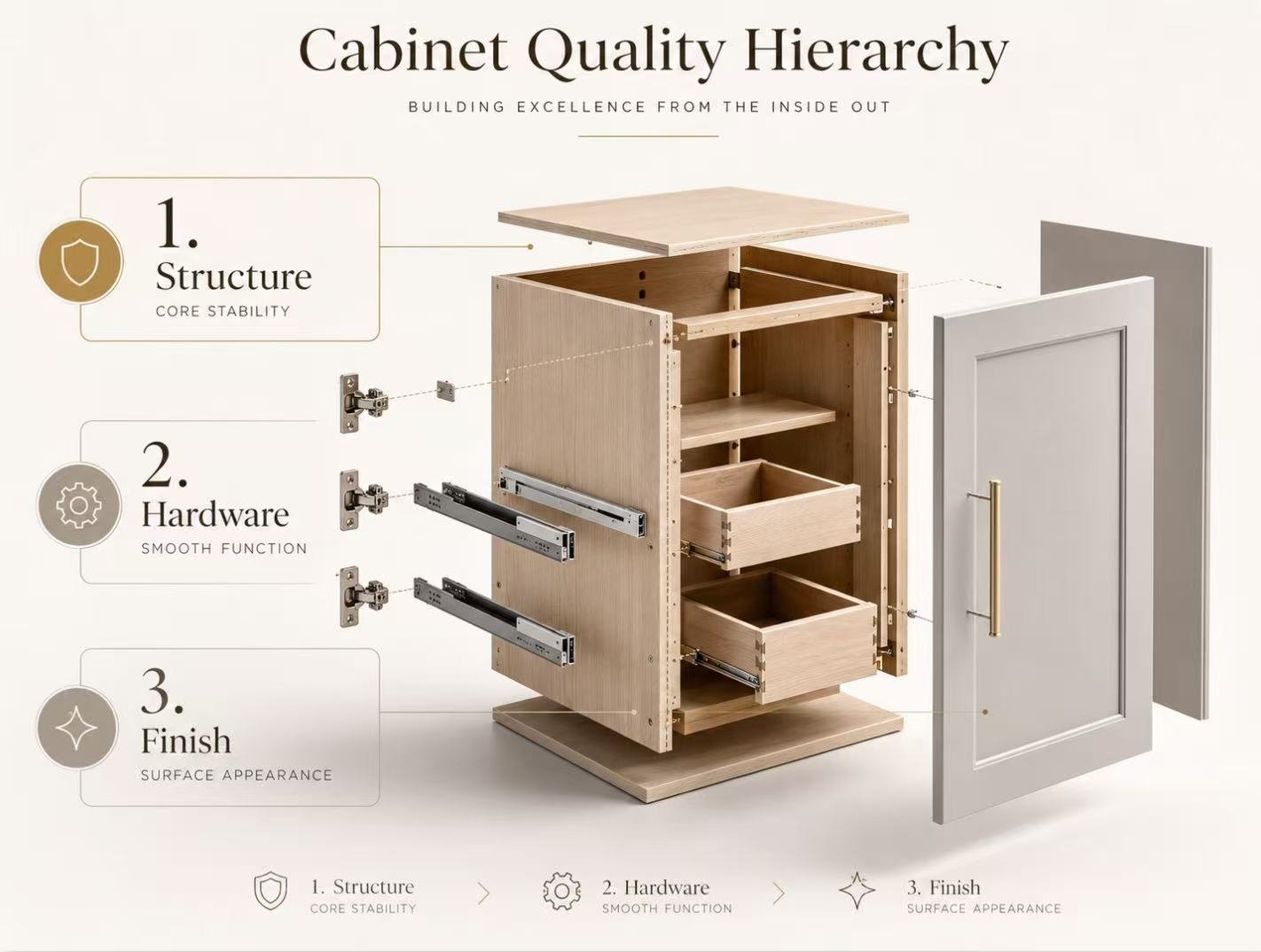
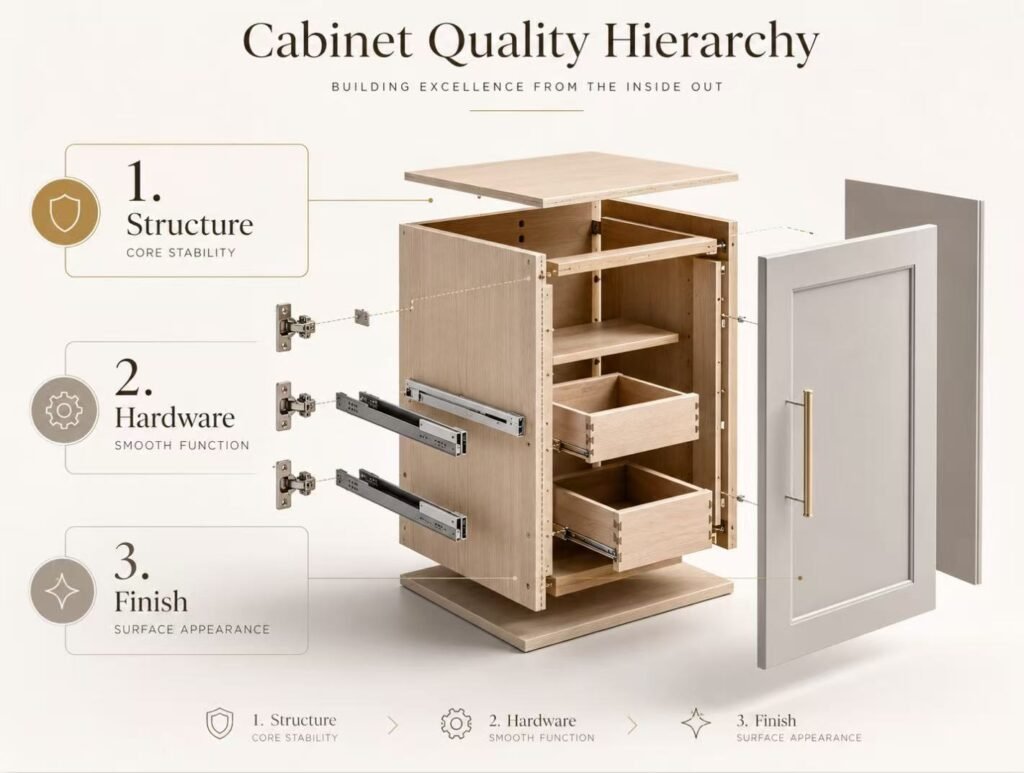
Quality in a kitchen cabinet follows a fairly consistent hierarchy: structural material and box construction matter most, since they determine whether the cabinet stays square and stable for years. Hardware — hinges and drawer slides — matters second, since it's what actually gets used daily. Finish matters third; it's the most visible layer, but the one least predictive of long-term performance. Price alone predicts none of these reliably, which is exactly why it's worth understanding each layer before comparing quotes.
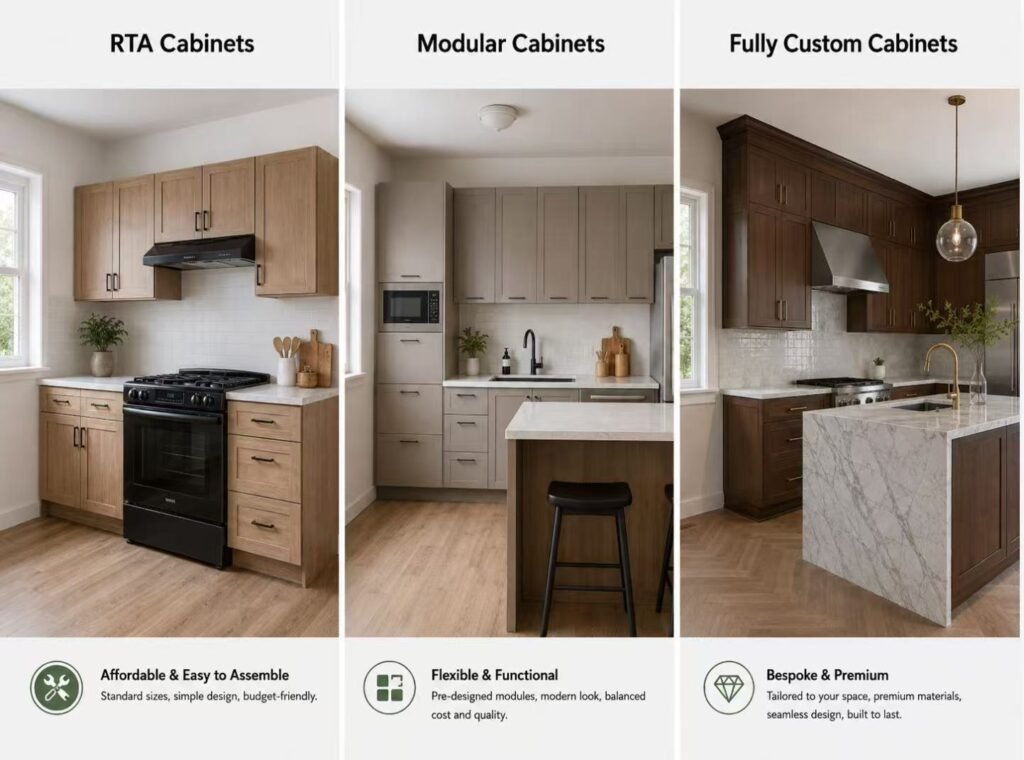
Kitchen Cabinet Types: Stock vs. Modular vs. Custom
Cabinet types by procurement model| Type | How it’s sourced | Best fit |
|---|
| Stock / RTA (ready-to-assemble) | Pre-set sizes, assembled on site or at delivery | Standard room shapes, faster timelines, tighter budgets |
| Modular | Standard-width modules combined to fit a space | Most residential kitchens, good balance of cost and fit |
| Fully custom | Built to exact project dimensions | Irregular layouts, luxury projects, hospitality developments |
The right category depends on the room, not on which one sounds more premium — a modular system for a standard-shaped kitchen can outperform an overpriced custom order for the same layout, a distinction covered in more depth in our modular kitchen cabinets guide.
03
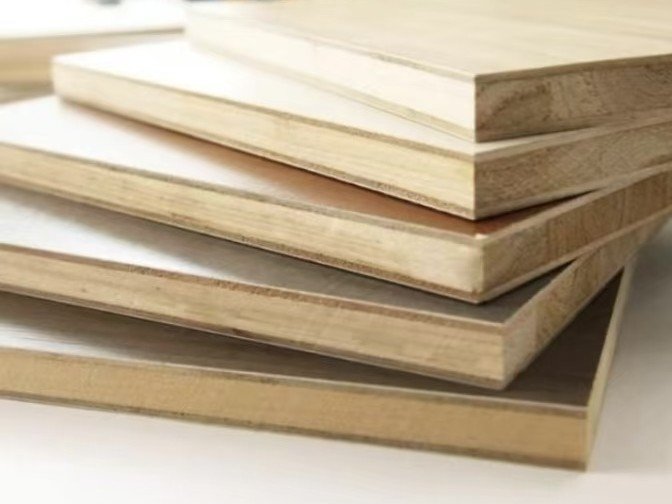
Cabinet Box Materials Compared: Plywood vs. MDF vs. Particleboard
Cabinet box material comparison| Material | Moisture tolerance | Screw-holding strength | Best use |
|---|
| Marine/cross-laminated plywood | Very good | Strong | Wet zones, humid climates, load-bearing sections |
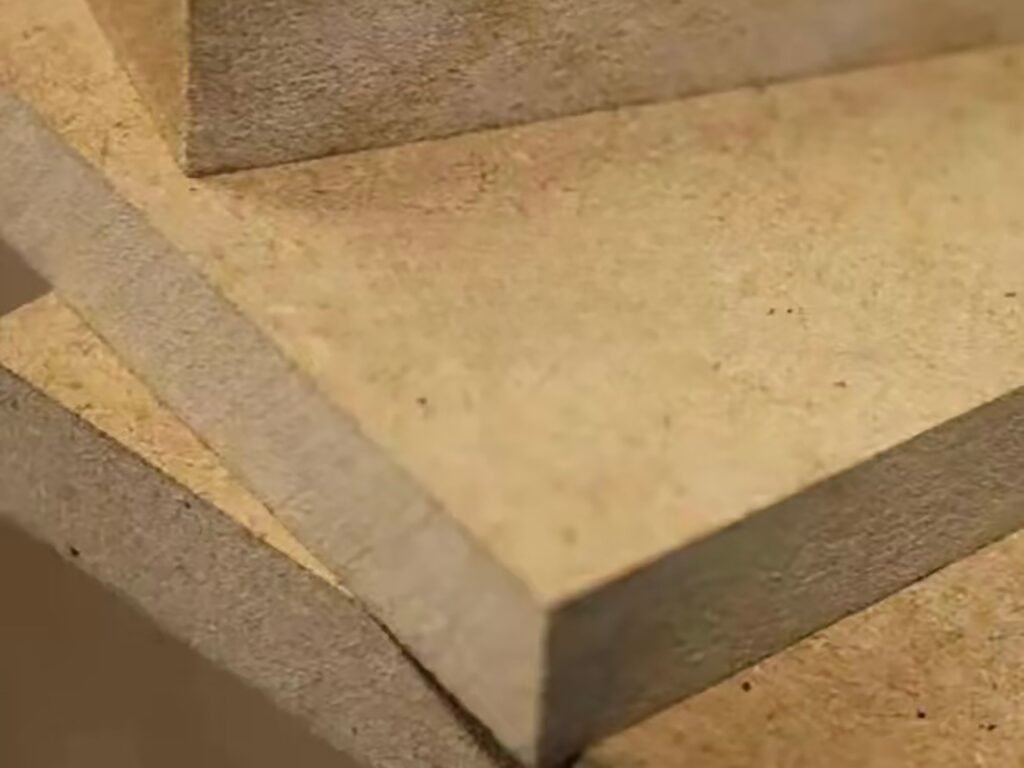
| MDF (MR/HMR grade) | Good, grade-dependent | Moderate to good | General cabinetry with verified moisture-resistant core |
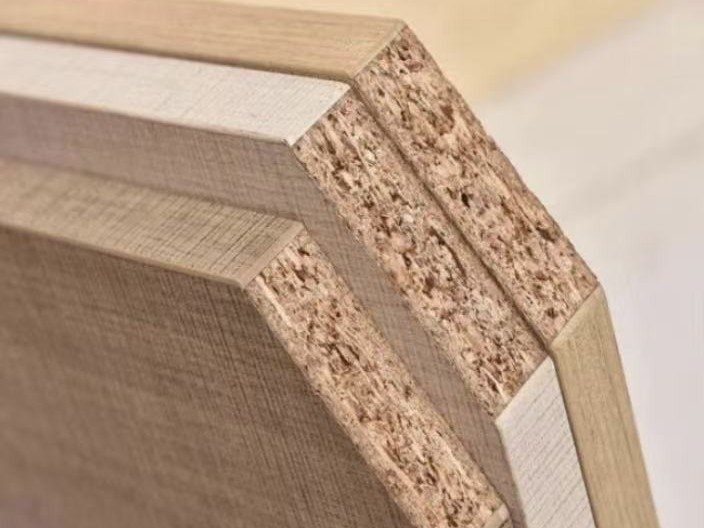
| Particleboard (standard grade) | Poor | Weaker, prone to screw pull-out over time | Dry, low-load areas only |
This isn’t a case of one material being universally “bad” — quality within each category varies enormously by density, core grade, and edge-sealing. A properly specified MR-grade MDF genuinely outperforms a poorly finished plywood, which is why the grade and test certificate matter more than the material name alone, a point covered in detail in our kitchen cabinet materials guide for Singapore’s climate.
04
Framed vs. Frameless Cabinets
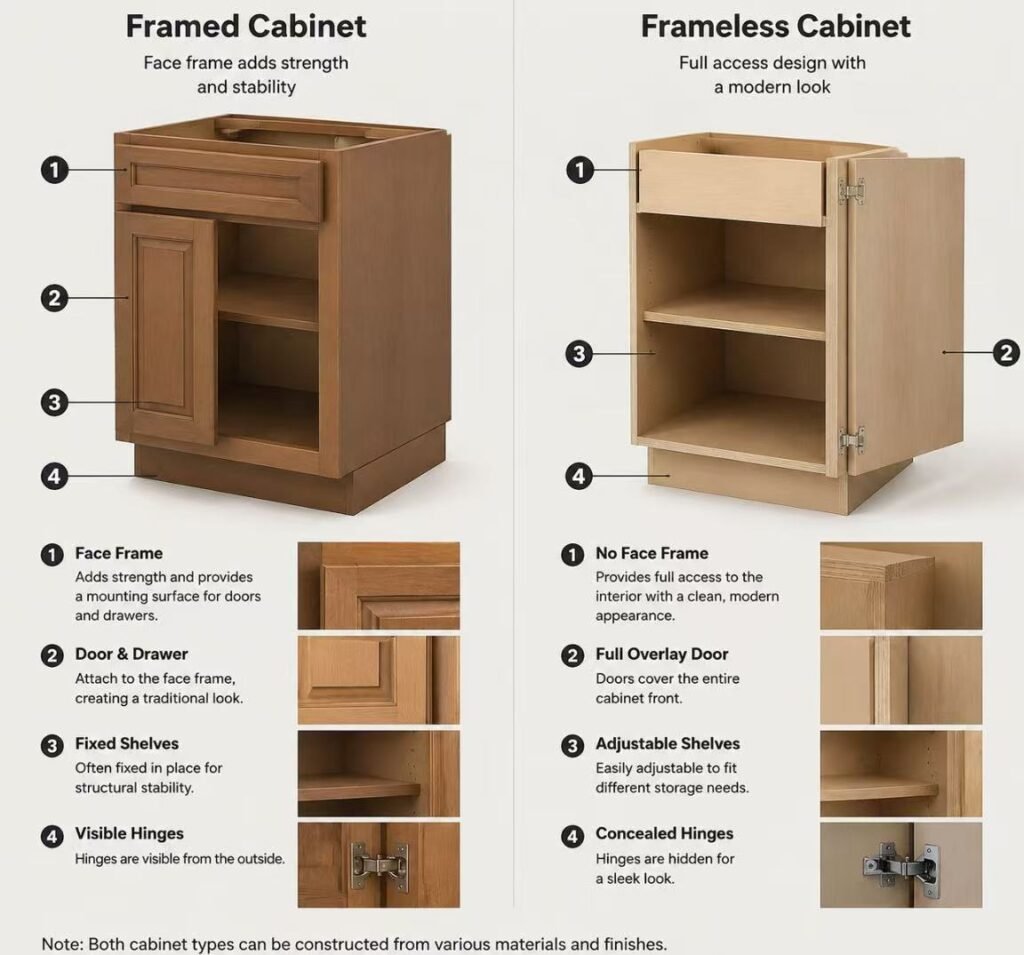
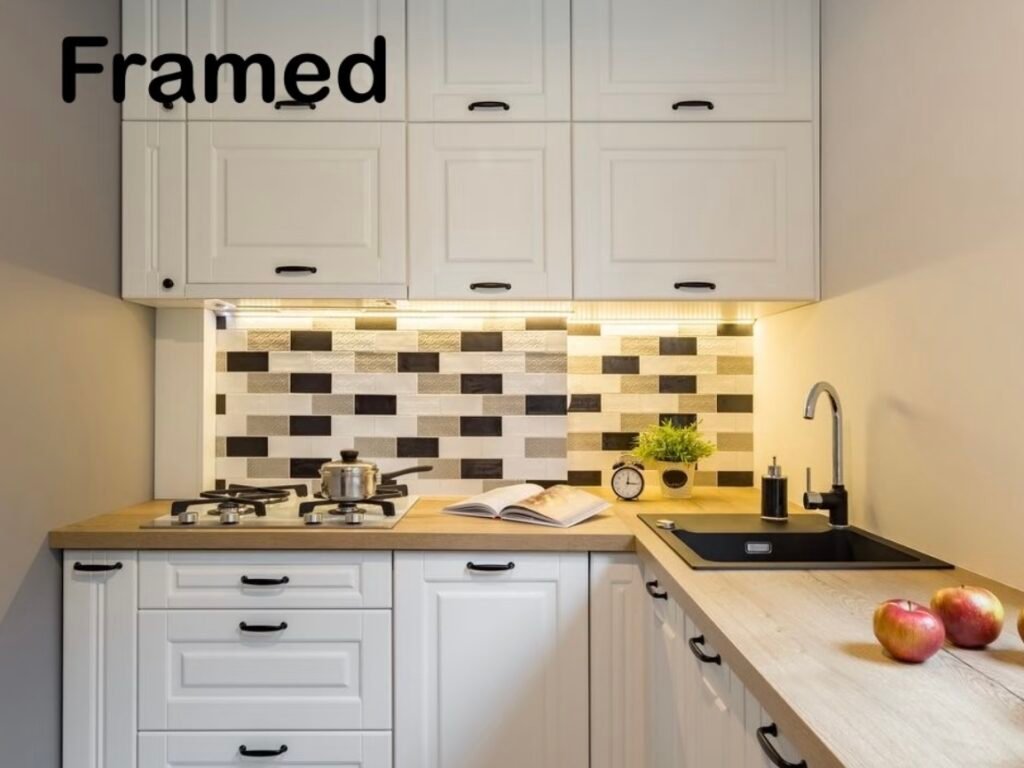
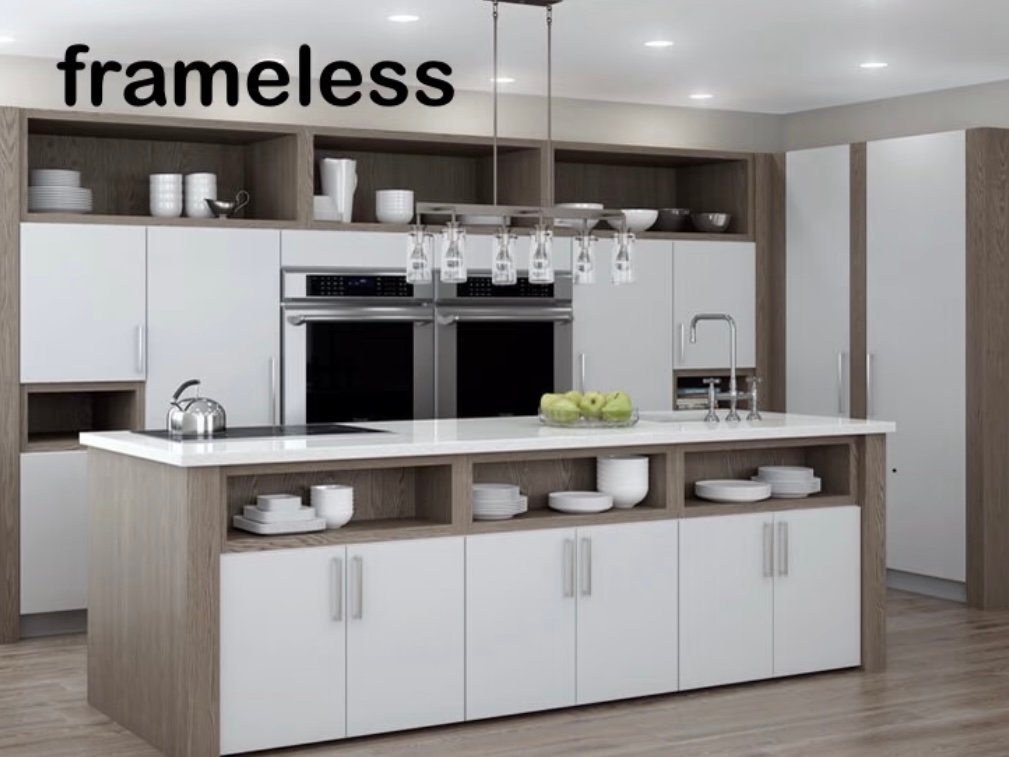
Framed cabinets use a face frame across the front of the box for added rigidity, while frameless (European-style) cabinets rely on thicker box panels and precise joinery instead. Neither is universally superior — framed construction offers a traditional look and slightly more forgiving installation tolerance, while frameless construction offers a cleaner, more contemporary appearance and marginally more interior storage access per cabinet. The right choice is a structural and design trade-off, not a quality verdict.
05
What Makes a Strong Cabinet Back Panel?
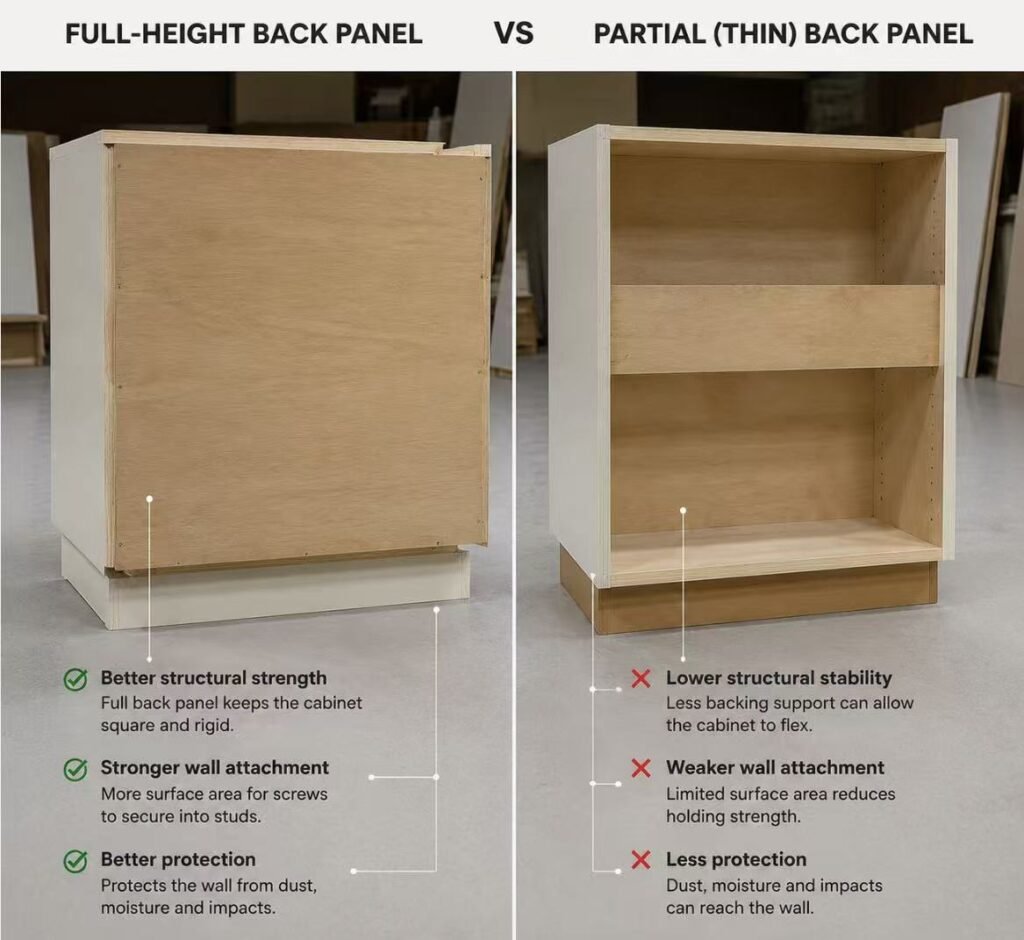
The back panel is one of the most overlooked quality indicators in a cabinet box. A full-height, full-thickness back panel adds meaningful rigidity to the entire cabinet, provides a solid surface for wall-fixing screws, and keeps the cabinet square during and after installation. A thin or partial back panel — common in budget stock cabinets — flexes more under wall-fixing tension and over time, which shows up as a cabinet that’s subtly out of square years after a perfectly good installation.
06
How to Judge Cabinet Hinges and Drawer Slides
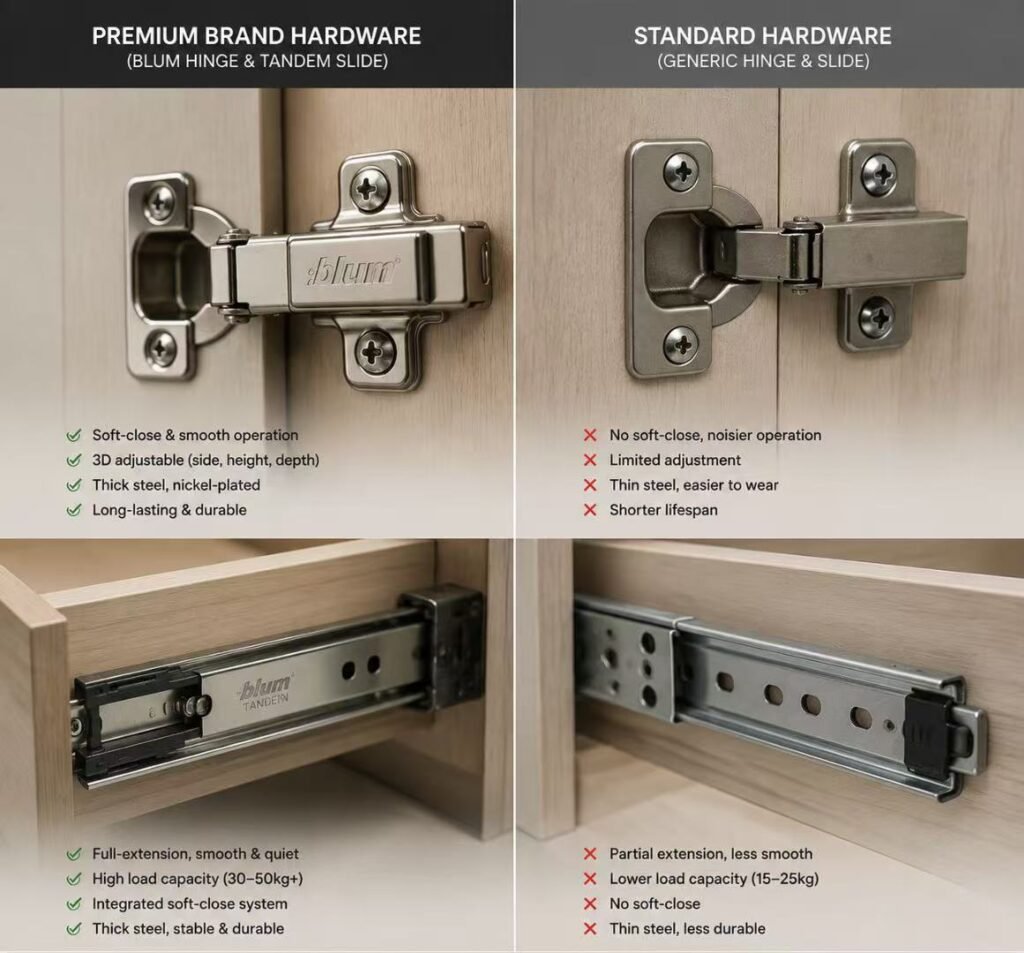
- Hinge cycle rating — branded soft-close hinges are commonly rated 50,000+ cycles; generic unbranded hardware is often rated closer to 15,000–25,000 cycles, even when both are marketed as “soft-close.”
- Drawer slide type — full-extension, soft-close, steel ball-bearing runners hold up significantly better under daily use than basic side-mounted plastic-roller runners.
- Load rating — heavier drawer applications (pots, appliances) need a slide rated well above the load it will actually carry, not just barely sufficient for it.
07
What Makes a High-Quality Drawer?
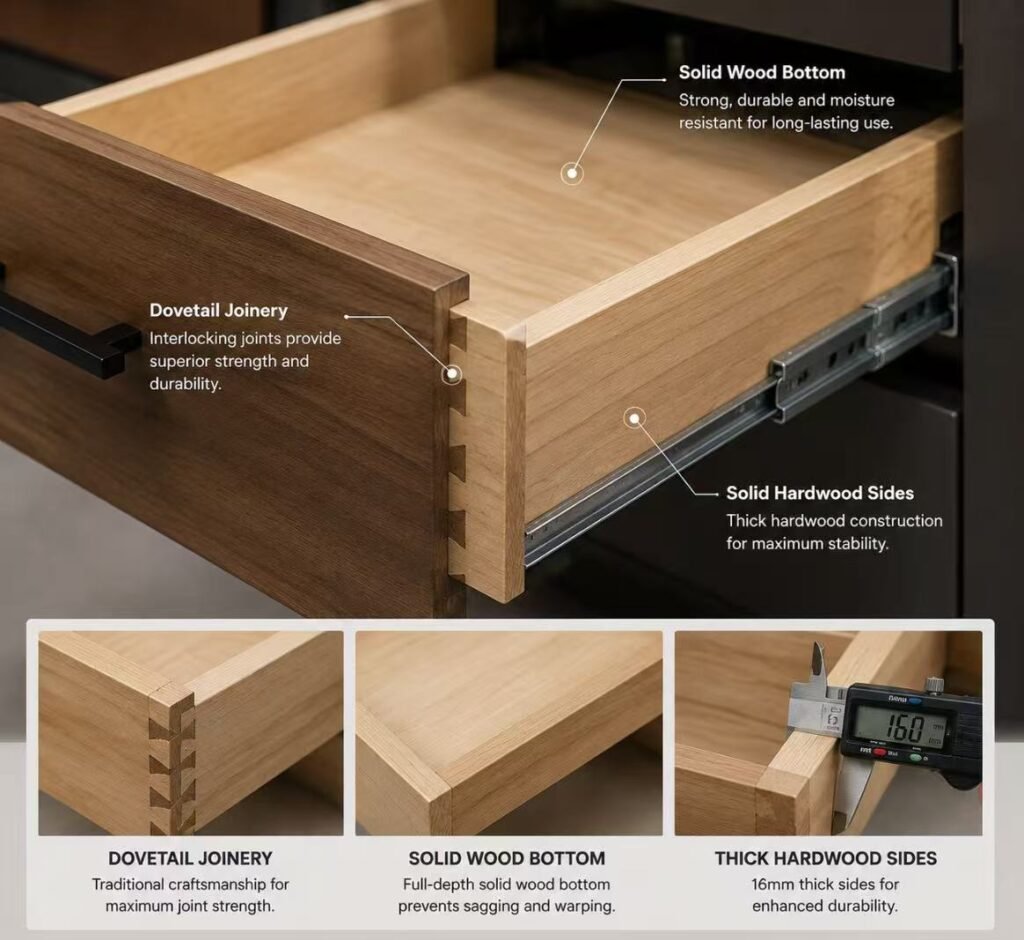
Drawer box construction is a genuine quality indicator, though the specific joinery method matters less than the joint’s overall strength. Reinforced corner joints (whether dovetail, dowelled, or cam-locked), a solid plywood bottom panel rather than thin hardboard, and adequate side-panel thickness all contribute to a drawer that holds its shape under repeated loading — a detail worth checking directly rather than assuming from the drawer’s outer finish.
08
Which Cabinet Finishes Are Most Durable?
Finish durability comparison| Finish | Scratch resistance | Moisture resistance |
|---|
| Matte lacquer | Moderate — shows scuffs more than gloss | Good, depends on substrate prep |
| High-gloss lacquer/acrylic | Good, but scratches show more visibly | Good |
| Laminate/melamine | Good | Very good — the most moisture-resistant common finish |
| Real wood veneer | Moderate — sensitive to prolonged moisture | Lower, needs proper sealing |
09
Low-Emission Materials & Certification
Formaldehyde emission grade is worth checking directly rather than assuming from a general “eco-friendly” label. E0 grade (≤0.5 mg/L) is the standard worth specifying for enclosed, air-conditioned kitchens, especially relevant in humid climates where off-gassing accelerates with heat — covered in full detail, including real test certificate examples, in our kitchen cabinet materials guide for Singapore’s climate.
Part Two
Why Windows Actually Fail
10
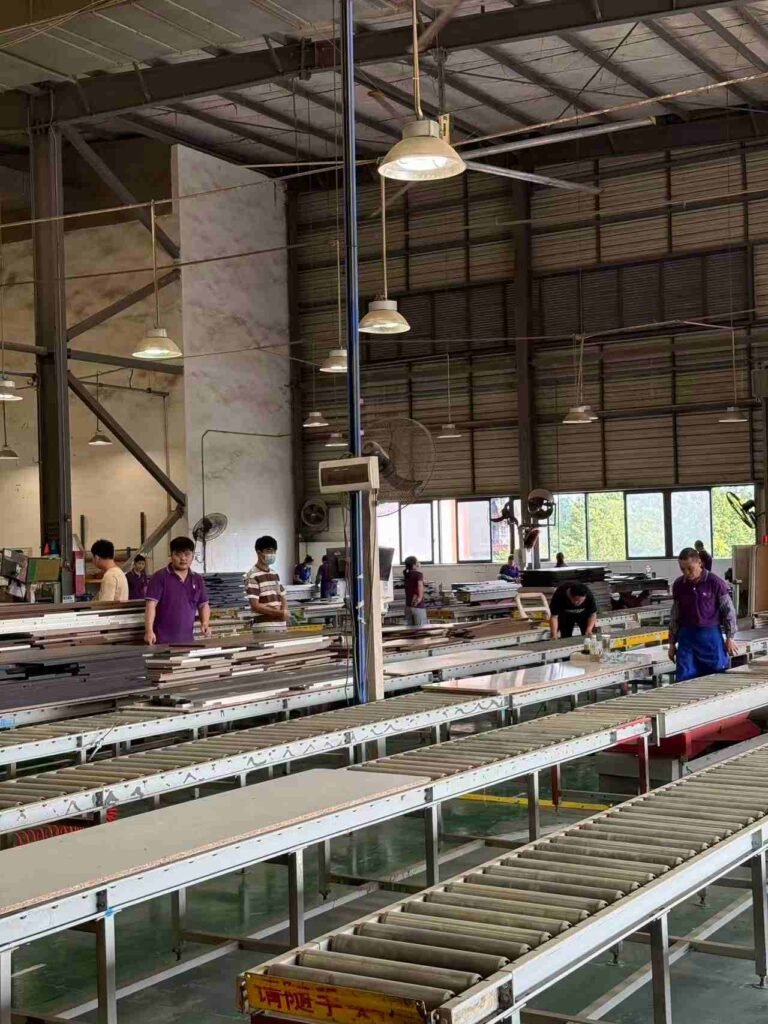
A High-Quality Cabinet Isn't Assembled — It's Built Through Sequential Stations
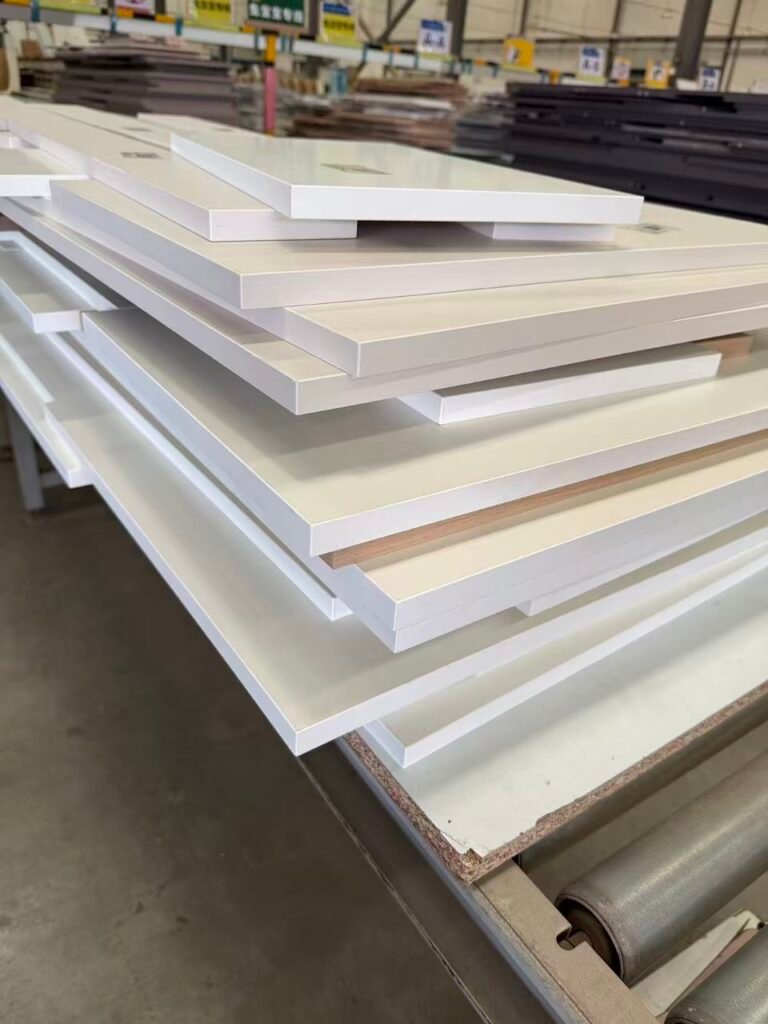
A cabinet box isn’t a set of independent steps that happen to occur in sequence — cut, edge-band, drill, finish, fit hardware. It’s a chain where the tolerance from one stage directly determines whether the next stage can align correctly. A board slightly out of spec at the cutting stage doesn’t stay a cutting problem; it becomes a hinge-alignment problem several stations later.
11
The Stations That Actually Determine Cabinet Quality
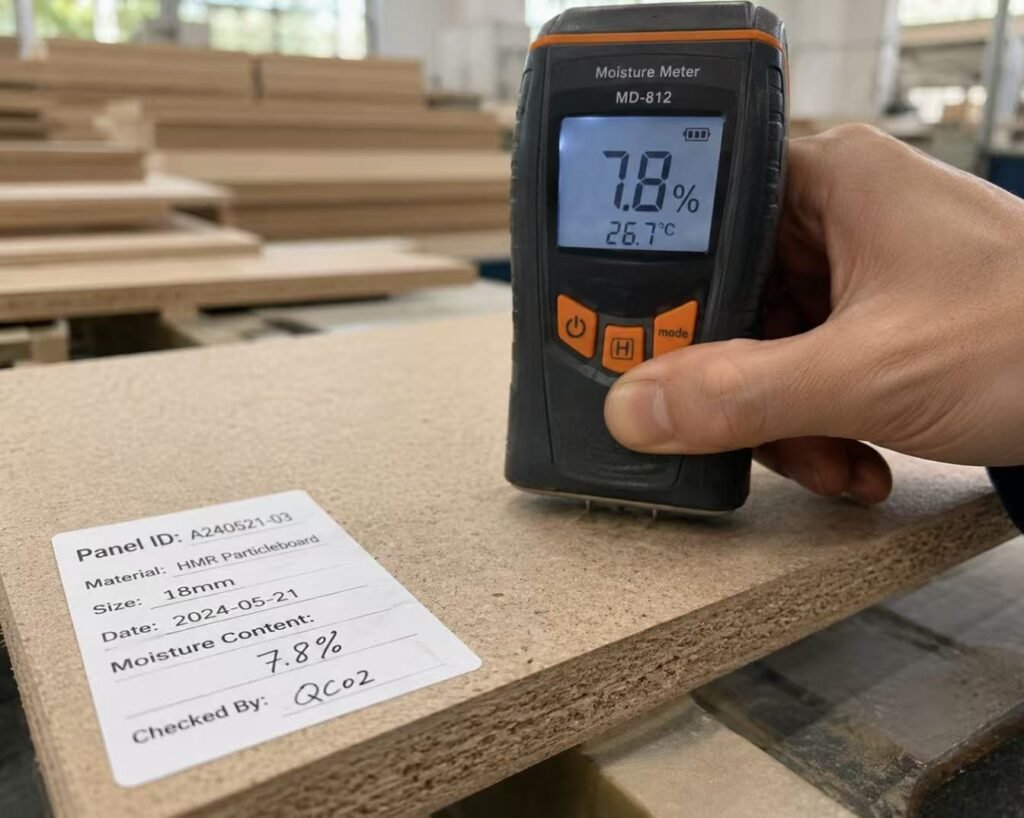
- Raw material moisture content check
- Panel cutting
- Edge-banding
- CNC drilling / hinge-cup machining
- Surface finishing (paint, veneer, or laminate)
- Hardware assembly
- Quality inspection
- Packing
12
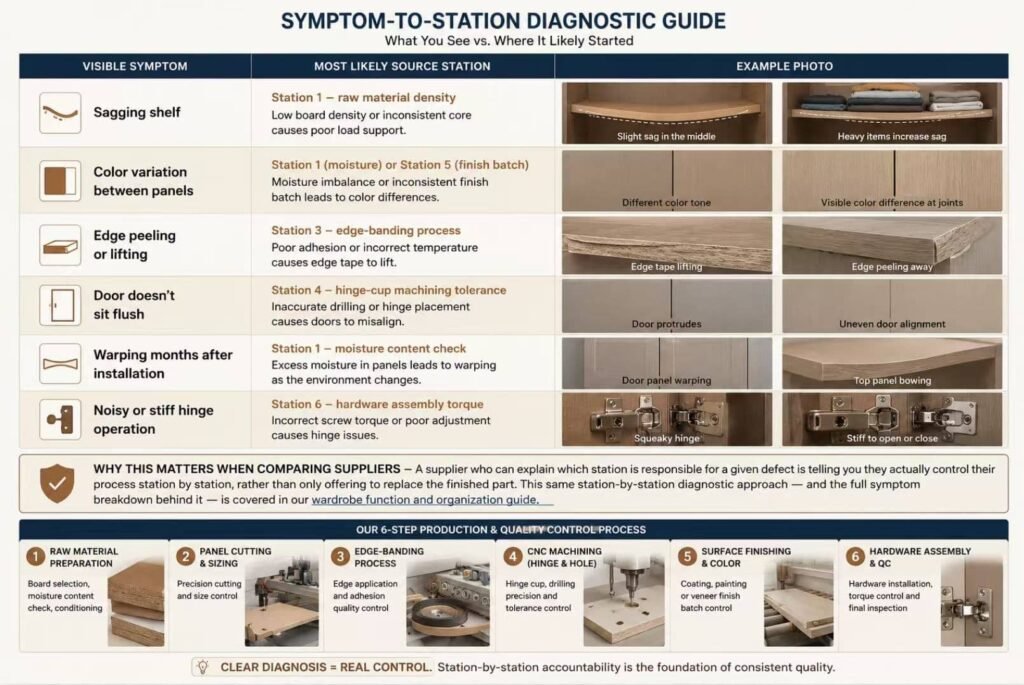
Why the Problem You See Isn't Always at the Station You Think
- A sagging shelf looks like a load-capacity problem, but often traces back to raw material density at Station 1, not the shelf bracket at Station 6.
- Visible color variation between panels looks like a finishing problem, but can originate from inconsistent moisture content at Station 1 causing uneven finish absorption at Station 5.
- A door that won’t sit flush looks like a hardware adjustment problem, but is frequently a hinge-cup machining tolerance issue from Station 4.
- Warping that appears months after installation looks like a delivery quality failure, but almost always traces back to inadequate moisture content control at Station 1.
13
Symptom-to-Station Diagnostic Table
What you see vs. where it likely started| Visible symptom | Most likely source station |
|---|
| Sagging shelf | Station 1 — raw material density |
| Color variation between panels | Station 1 (moisture) or Station 5 (finish batch) |
| Edge peeling or lifting | Station 3 — edge-banding process |
| Door doesn’t sit flush | Station 4 — hinge-cup machining tolerance |
| Warping months after installation | Station 1 — moisture content check |
| Noisy or stiff hinge operation | Station 6 — hardware assembly torque |
14
The 15-Point Cabinet Quality Checklist
Most cabinet buying guides describe quality in the abstract. Here’s what to actually check, in a showroom or against a sample:
Part Three
Climate, Cost & Sourcing
15
How Does Humidity Affect Kitchen Cabinet Quality?
In Singapore, Malaysia, and other humid Southeast Asian markets, Station 1 — raw material moisture content — matters more than almost any other single factor, since a board that passes a loose moisture threshold in a drier climate can still swell, bind, or warp under continuous tropical humidity exposure. This is covered in full technical depth, including real test certificate data, in our kitchen cabinet materials guide for Singapore’s climate and our Kitchen Cabinet Malaysia guide.
16
Are Expensive Kitchen Cabinets Always Better?
Not automatically. Price reflects a combination of material grade, hardware brand, customization level, and brand positioning — not a guaranteed quality ranking on its own. A mid-priced cabinet with verified moisture-resistant core, branded hardware, and documented QC can outperform a higher-priced option sold mostly on finish and brand name. The 15-point checklist above is a more reliable value indicator than price alone.
17
Factory-Assembled vs. RTA Cabinets
Factory-assembled cabinets are generally more dimensionally accurate and structurally consistent, since joinery and hardware installation happen under controlled factory conditions rather than on-site. RTA (ready-to-assemble) cabinets reduce shipping cost and lead time, but shift assembly accuracy to whoever installs them — a genuine trade-off between cost/speed and consistency, not a simple quality downgrade.
18
What Makes Kitchen Cabinets "High-End"?
High-end cabinetry isn’t defined by material cost alone — it’s defined by customization accuracy, hardware consistency, internal storage planning, and detailing consistency across every unit in the kitchen. A kitchen built with well-planned internal drawer organization and consistent reveal lines between doors reads as high-end even with mid-range materials, while mismatched panel colors or misaligned doors undercut even genuinely premium materials.
19
How Long Should Quality Kitchen Cabinets Last?
Well-specified cabinetry with a moisture-resistant core, branded hardware, and proper finish typically lasts 15–20+ years in normal residential use. Budget cabinetry with standard-grade particleboard and generic hardware more commonly shows structural or hardware issues within 5–8 years, particularly in humid climates.
20
How Much Do High-Quality Kitchen Cabinets Cost?
Rather than a single price figure, cost should be understood as a sum of specific line items: box material grade, hardware brand and rating, finish type, and level of customization. Two quotes at the same headline price can represent very different actual specifications — which is exactly why the 15-point checklist matters more than comparing bottom-line numbers alone.
21
Sourcing High-Quality Cabinets With Verified Construction
At BoyceCasa, cabinet box material, moisture resistance grade, and hardware specification are backed by test certificates provided before production — not stated as a general claim after the fact — and tracked station by station from raw material moisture content through final inspection. For multi-unit and hospitality projects, finish is checked against a retained master sample across every batch. This same standard applies across our kitchen cabinets, wardrobe, and interior doors lines.
Comparing kitchen cabinet quotes? Run the 15-point checklist against each supplier before comparing prices — box material, back panel, hardware rating, and QC records predict long-term value far better than the finish photo alone.
FAQS
Explore our Kitchen Cabinets and Wardrobe collections to see factory-direct cabinetry for villa and hotel projects, or contact our team for a project-specific consultation and quote.
Related reading:
Kitchen Cabinet Materials in Singapore: Density, Moisture Resistance & What the Test Reports Actually Say →
Best Material for Kitchen Cabinets: Choosing by Budget, Climate & Upkeep →
Laminate Kitchen Cabinets: The Real Quality Checklist →
Modular Kitchen Cabinets: What "Modular" Actually Means Beyond Pre-Fabricated →
Kitchen Cabinet Malaysia: What Actually Lasts in a Humid Climate →
Wardrobe Function and Organization: A Planning & Quality Guide →