Blog

Office Decor: Why Storage Design Matters More Than the Accessories

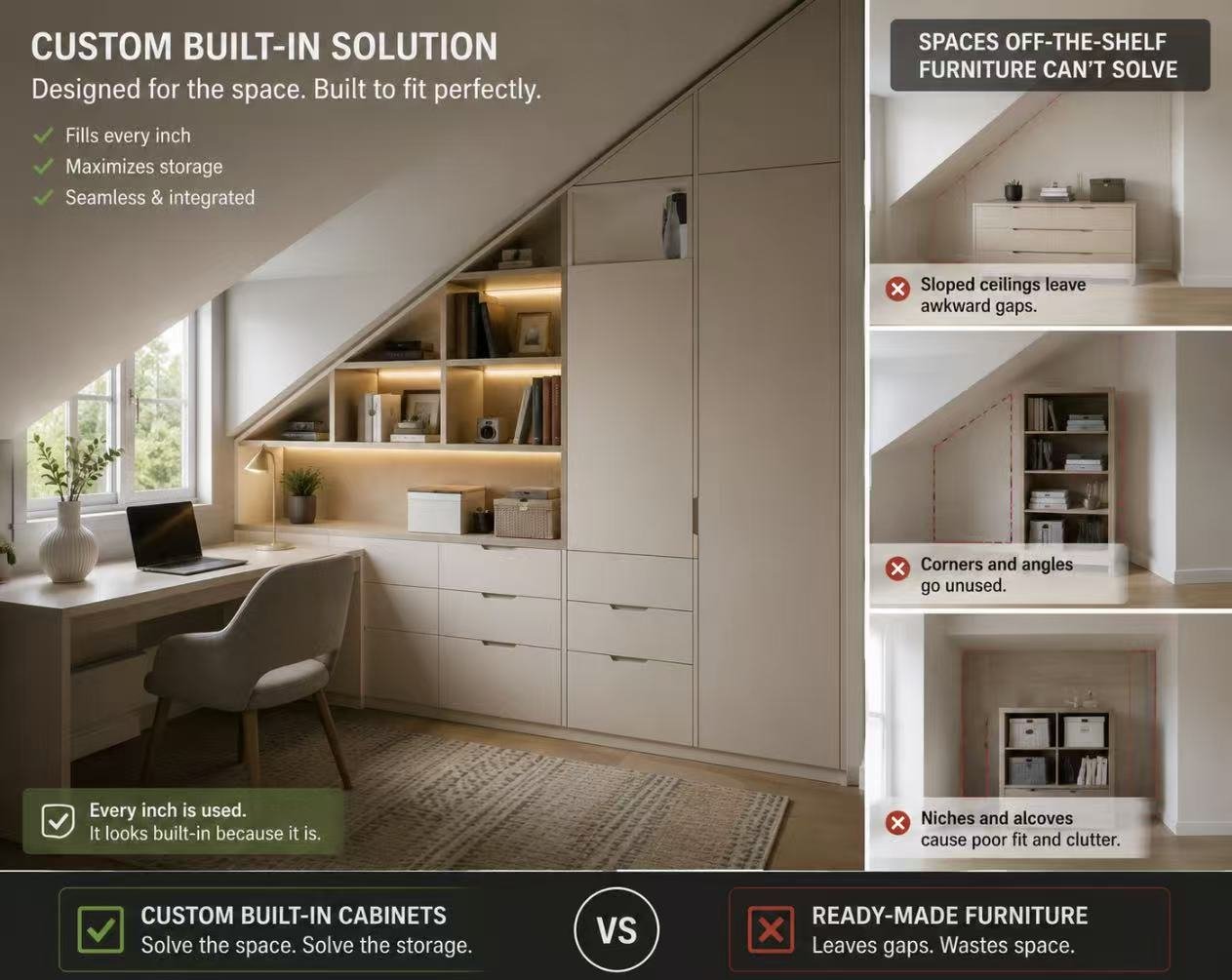
Custom built-in storage irregular office space

In the pursuit of personalized spaces and premium living, mass-produced furniture often falls short of capturing the true essence of a home.

As modern minimalism and light luxury styles continue to dominate global design trends, high-end custom furniture has become the absolute core of creating an ideal living space.However, the custom furniture market can be highly complex.

Bridging the gap between a stunning design blueprint and the final product involves navigating materials, hardware, and craftsmanship. Here is how to choose bespoke luxury furniture like a professional designer.

You've bought the plants, upgraded the lighting, added a diffuser — and the office still feels cluttered. Almost every office decor guide stops at the accessory layer. This one starts where the real problem actually lives: how the storage itself is sized and built.

If you've read a few office decor guides already, you've noticed they all suggest roughly the same things: better lighting, a plant or two, cable management, a nice diffuser. All genuinely helpful — and all addressing the surface of a problem that usually starts somewhere else entirely. This guide covers the layer underneath the accessories: whether your office actually has the storage capacity and layout it needs in the first place.

Read time — 9 min
Covers — Storage sizing · Built-in vs. off-the-shelf · Camera-ready setups
Focus — What decor can't fix

The Accessory Trap: Why Decor Alone Doesn't Fix a Cluttered Office

Plants improve air quality and mood. Better lighting reduces eye strain. A diffuser makes a room more pleasant to sit in. None of these things add storage capacity. If your desk keeps re-cluttering within days of a clean-up, the honest diagnosis usually isn't "not enough decor" — it's "not enough places to put things," and no amount of styling fixes a capacity problem.
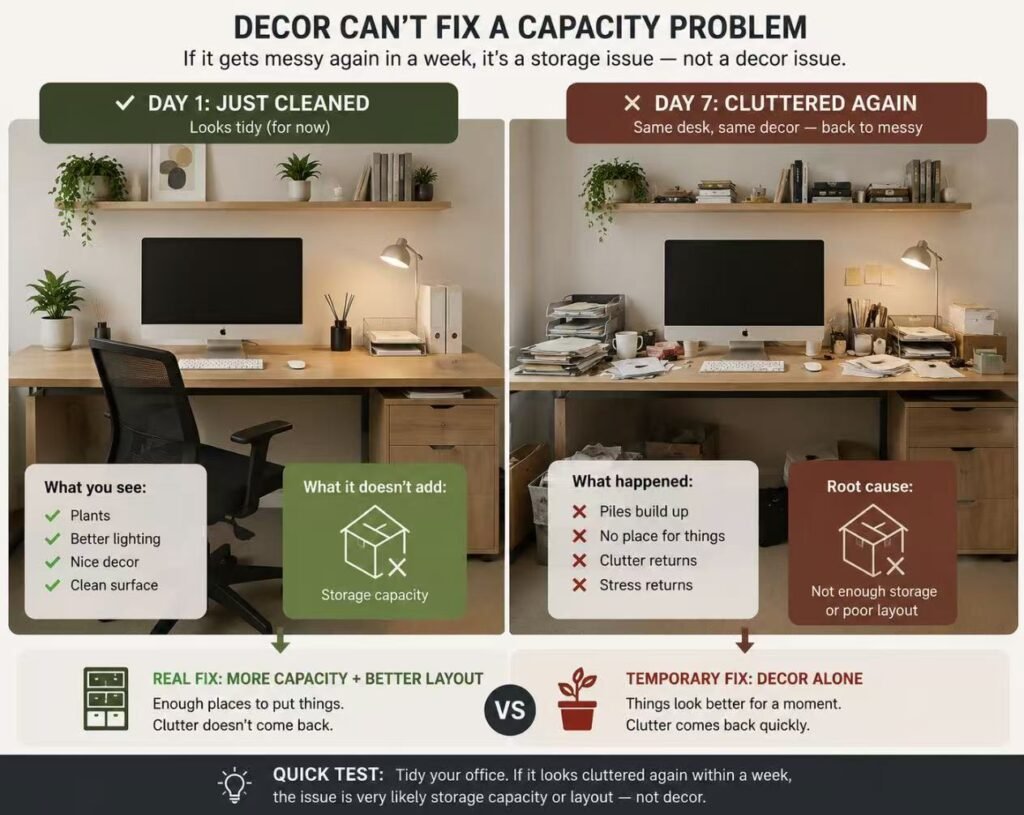
Home office clutter returns after tidying

A quick test — if you tidy your office and it looks cluttered again within a week, the issue is very likely storage capacity or layout, not decor. If it stays tidy for weeks and just feels flat or uninspiring, that’s genuinely a decor problem, and the lighting/plants/color advice below will help.

Built-In Storage vs. Loose Accessories: What Each Actually Solves

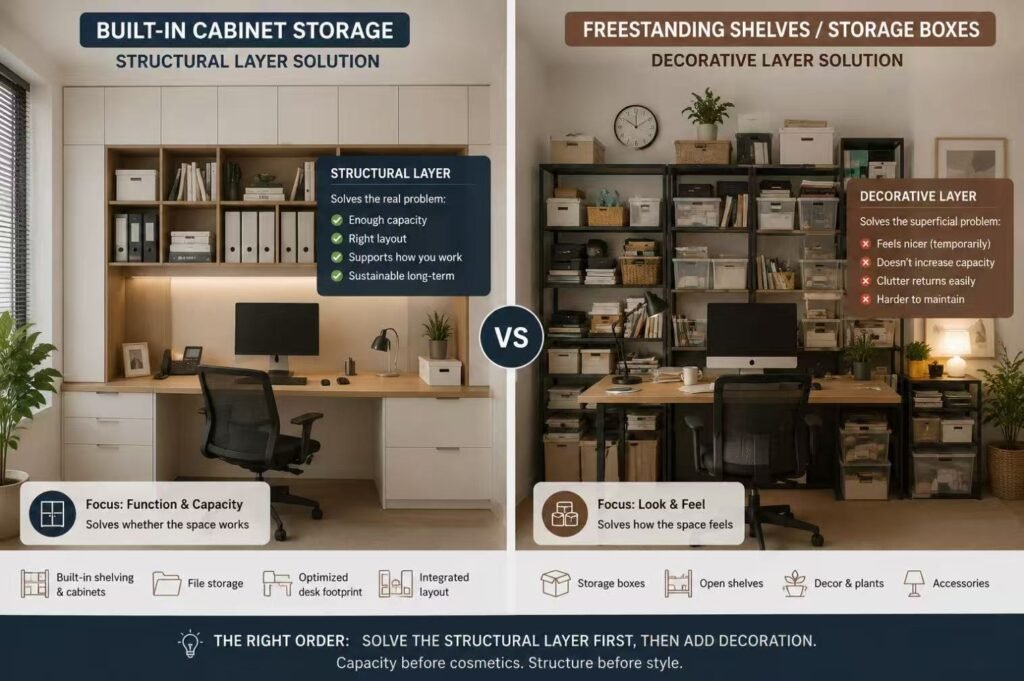
Two different layers of an office, two different problems
LayerIncludesSolves
Structural layerBuilt-in shelving, cabinets, file storage, desk footprintWhether there’s actually enough capacity and the right layout for how you work
Decorative layerLighting, plants, rugs, wall art, scentHow the space feels once the structural layer is already working
Built-in office storage versus loose accessories

Most office decor content addresses only the decorative layer, which is a reasonable scope for a styling article — but it means the advice only works if the structural layer is already sound. Fixing the structural layer first, then layering decor on top, is a more reliable order than the reverse.

Sizing Your Home Office Storage: The Numbers Most Guides Skip

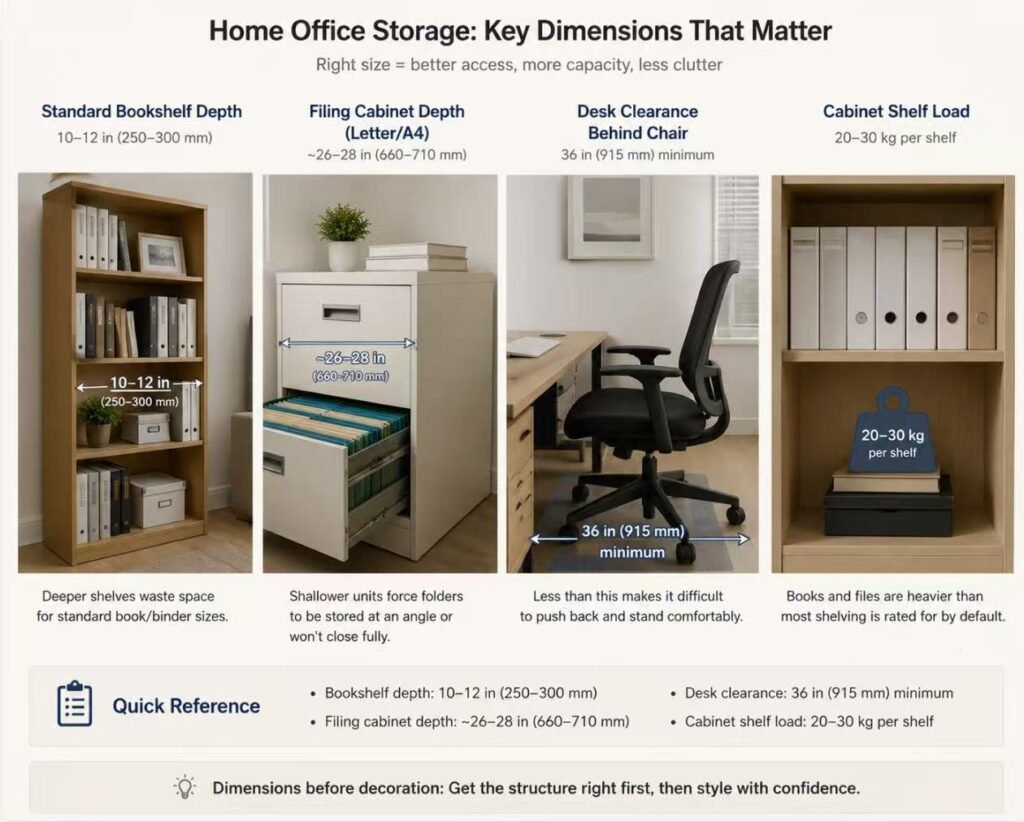
Office shelf and filing cabinet depth measurements
Storage sizing reference for a home office
ElementTypical sizingWhy it matters
Standard bookshelf depth10–12 in (250–300 mm)Deeper shelves waste space for standard book/binder sizes
Filing cabinet depth (letter/A4)~26–28 in (660–710 mm)Shallower units force folders to be stored at an angle or won’t close fully
Desk clearance behind chair36 in (915 mm) minimumLess than this makes it difficult to push back and stand comfortably
Cabinet shelf load20–30 kg per shelf (standard), higher for reinforced shelvingBooks and files are heavier than most shelving is rated for by default

These numbers matter more than any styling choice, because a shelf that’s the wrong depth or a cabinet that can’t structurally hold a full run of binders will feel cluttered no matter how it’s decorated — the problem is dimensional, not aesthetic.

Color & Light: What the Psychology Actually Says

Color and lighting do have a real, if modest, effect on focus and mood — blues and greens are generally associated with calm and concentration, yellows with creativity, and warm-white lighting (rather than cool fluorescent tones) tends to feel more comfortable for long work sessions. This is worth applying once the storage layer is sorted, but it’s a finishing touch, not a fix for a fundamentally under-sized or poorly laid out space.

When Your Home Office Also Needs to Look Professional on Camera

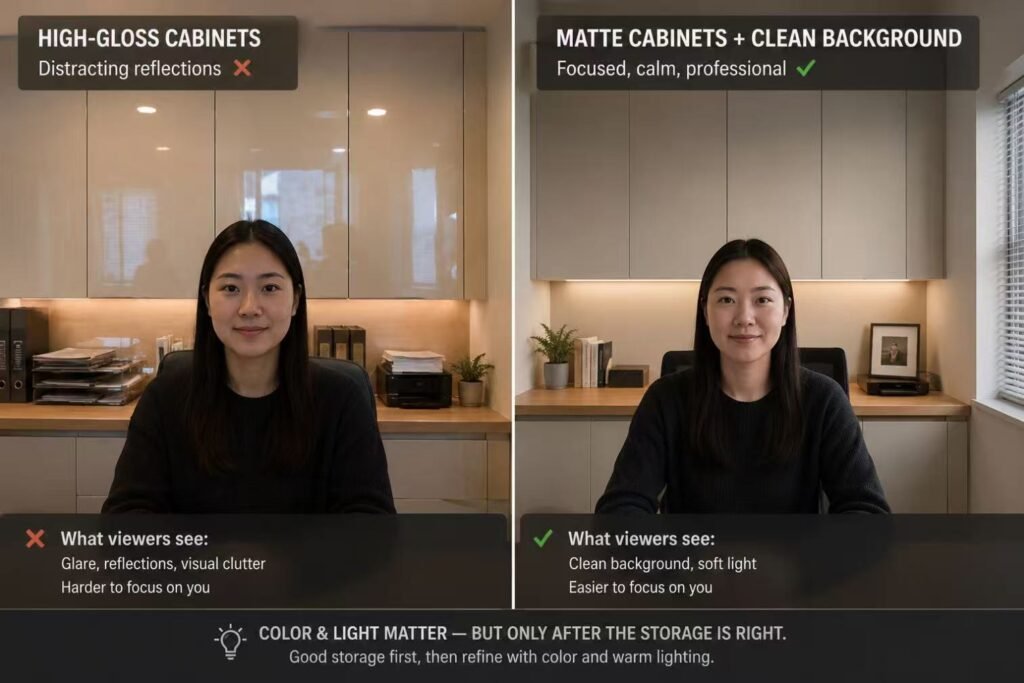
Glossy versus matte cabinet on video call background

Video calls have made a detail relevant that most decor guides don’t address: what’s actually visible in the background matters as much as how the room feels to sit in day-to-day. A few specifics worth checking:

  • Glossy cabinet doors can create glare or reflections under camera lighting — a matte finish generally reads better on screen.
  • Open shelving visible in frame should be curated deliberately, since cluttered open storage is far more noticeable on camera than in person.
  • Consistent, enclosed storage behind the camera-facing wall keeps the background clean without requiring constant tidying before every call.

Custom vs. Off-the-Shelf Storage: When It's Worth Building In

Off-the-shelf storage is the right call for a standard-sized room and a modest, stable storage need. Custom built-in storage earns its cost specifically when:

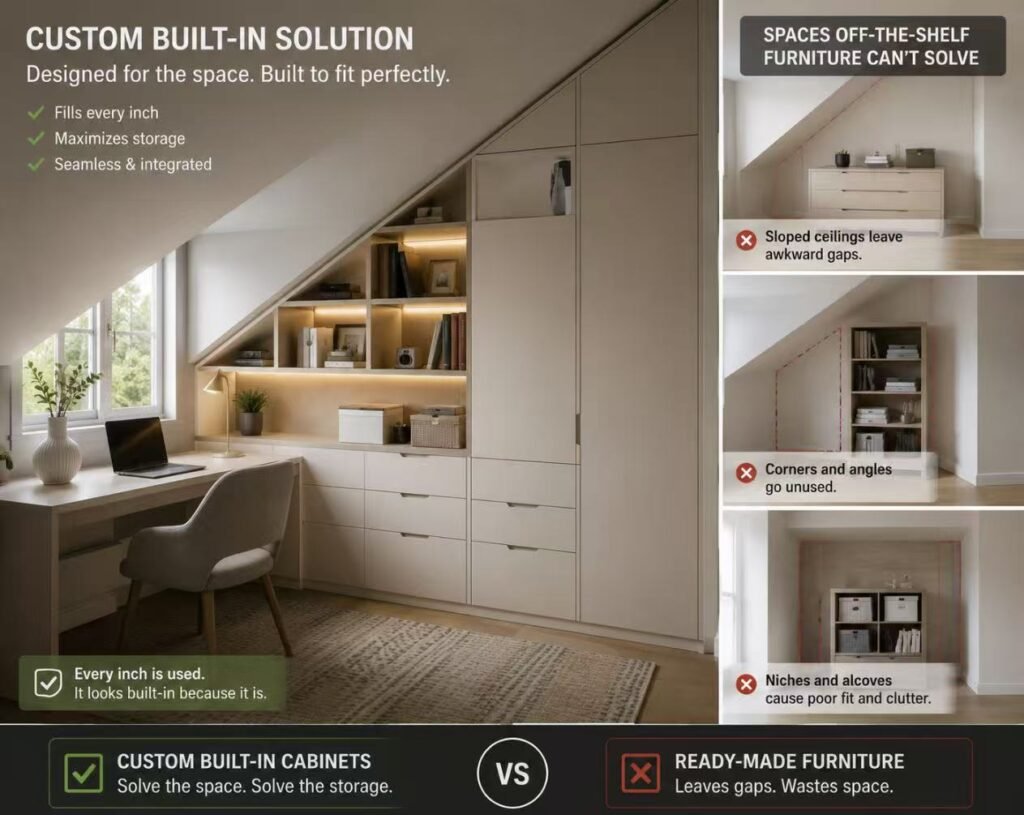
Custom built-in storage irregular office space
  1. The room has an irregular footprint — an alcove, a sloped ceiling, or an awkward corner that off-the-shelf units can’t use efficiently.
  2. Storage needs are long-term and substantial — a permanent home office rather than a temporary setup.
  3. Camera-ready consistency matters — built-in storage can be designed around exactly what should and shouldn’t be visible on a call.
  4. You’re maximizing a small space — built-in units can use every inch of depth and height in a way modular furniture generally can’t.

Sourcing Office Storage That's Actually Built for Your Space

At BoyceCasa, built-in office storage is designed around the actual room dimensions and the owner’s real storage volume — shelf depth, cabinet capacity, and layout confirmed before any finish or color decision is made — rather than starting from a styling concept and hoping the storage fits around it. This same sizing-first approach extends across our wardrobe, kitchen cabinets, and interior doors lines.

Planning a home office that needs to actually hold your stuff? Solve the storage capacity and layout first — the lighting, color, and accessories will do far more once that’s right.


FAQS

Why does my home office keep getting cluttered no matter how I decorate it?

This usually indicates a storage capacity or layout problem rather than a decor problem. If tidying only holds for a few days, the space likely doesn't have enough storage for what you actually need to keep in it.

Off-the-shelf furniture works well for standard room shapes and modest storage needs. Built-in storage is worth the investment for irregular room footprints, long-term substantial storage needs, or when you want full control over what's visible during video calls.

Check for glare on glossy cabinet surfaces, curate anything visible on open shelving deliberately, and consider enclosed storage behind the camera-facing wall to keep the background consistently tidy without last-minute rearranging.

Yes, modestly. Warm-white lighting is generally more comfortable for long work sessions than cool fluorescent tones, and colors like blue and green are commonly associated with calm and concentration, though this is a refinement rather than a fix for insufficient storage or poor layout.

Standard bookshelf depth is typically 10–12 inches (250–300 mm), sized for most books and binders without wasting space — deeper shelves are usually unnecessary unless storing larger format items.

Explore our Kitchen Cabinets and Wardrobe collections to see factory-direct cabinetry for villa and hotel projects, or contact our team for a project-specific consultation and quote.
Related reading:
Typical Door Dimensions & Standard Door Height (mm): A Complete Guide
Door Rough Opening Size: The Complete Chart & Sourcing Guide
Windows and Doors: A Complete Buying & Sourcing Guide
Window and Door Materials
Aluminium Doors & Windows for Hot Climate Projects
Kitchen Cabinets Singapore: A Sourcing Guide for Developers & Interior Designers
Kitchen Cabinet Materials in Singapore: Density, Moisture Resistance & What the Test Reports Actually Say
HDB & Condo Kitchen Layouts: What Actually Goes Wrong at Installation
Let’s Discuss, Your Project.

Tell us about your project requirements and we’ll connect you with the right team. We typically respond within 24 hours on business days.

Call / WhatsApp
Offices
Located on Central Avenue, Nanhai District, Foshan City, Guangdong Province

Start a Conversation

Fill in your details and we’ll be in touch shortly.


Scroll to Top